

We saw some statistical oddities with a few players this season and I believe it would be helpful to look at their numbers against the backdrop of those who came before them, if such performances even exist. I believe this is a helpful exercise to see how the projections are looking into these players without being so dismissive of those numbers as they come out. Since we just witnessed the Chicago White Sox strike out 75 times in a five-game series while setting a new record in the process, let's start with strikeouts.
The White Sox had the only two players with at least 500 plate appearances who struck out at least 35 percent of the time in Munetaka Murakami and Colson Montgomery. Despite the strikeouts, the duo still returned positive fantasy value thanks to their plethora of home runs:
| PLAYER | HR | BA | K% | RANK | 12-Team $ | 15-Team $ |
|---|---|---|---|---|---|---|
| Munetaka Murakami | 35 | .207 | 35.4% | 113 | $11 | $14 |
| Colson Montgomery | 31 | .197 | 35.6% | 158 | $8 | $11 |
There are just five instances of a player striking out at a higher rate that either of these players did over the course of 500 or more plate appearances, and the names should not surpise you. Chris Davis struck out in 37.2 percent of his 2017 plate appearances and in 36.8 percent of his 2018 plate appearances. He hit 26 and 16 home runs in those seasons while hitting .215 in 2017 and .168 in 2018 before he was out of the league. Joey
We saw some statistical oddities with a few players this season and I believe it would be helpful to look at their numbers against the backdrop of those who came before them, if such performances even exist. I believe this is a helpful exercise to see how the projections are looking into these players without being so dismissive of those numbers as they come out. Since we just witnessed the Chicago White Sox strike out 75 times in a five-game series while setting a new record in the process, let's start with strikeouts.
The White Sox had the only two players with at least 500 plate appearances who struck out at least 35 percent of the time in Munetaka Murakami and Colson Montgomery. Despite the strikeouts, the duo still returned positive fantasy value thanks to their plethora of home runs:
| PLAYER | HR | BA | K% | RANK | 12-Team $ | 15-Team $ |
|---|---|---|---|---|---|---|
| Munetaka Murakami | 35 | .207 | 35.4% | 113 | $11 | $14 |
| Colson Montgomery | 31 | .197 | 35.6% | 158 | $8 | $11 |
There are just five instances of a player striking out at a higher rate that either of these players did over the course of 500 or more plate appearances, and the names should not surpise you. Chris Davis struck out in 37.2 percent of his 2017 plate appearances and in 36.8 percent of his 2018 plate appearances. He hit 26 and 16 home runs in those seasons while hitting .215 in 2017 and .168 in 2018 before he was out of the league. Joey Gallo also had two similar seasons, with a 36.8 percent strikeout rate in 2017 and a 35.9 percent rate in 2018. Gallo did hit 40 home runs in each of those seasons in the former hitter-friendly Texas home park, but he failed to hit even .210 in either season. Finally, Chris Carter was given all the playing time he wanted for the rebuilding 2013 Houston club, and the big man hit 29 homers with a .223 average while striking out 36.2 percent of the time.
Simply put, this duo has to continue to hit 30 or more home runs to offset the drain on batting average and the impact of that on their run and RBI production. Mark Reynolds had a similar season to Montgomery in 2010 when he hit 32 home runs and drove in 85 runs around a .198 batting average in 2010. Reynolds then went on to sign with Balitmore in 2011 and hit 37 home runs, drove in and scored 80-plus runs while raising his batting average to .223. In each of these other cases, Gallo, Davis, Carter and Reynolds benefitted from much friendler home parks than Rate Field.
Then again, Montgomery could do what Zack Gelof did just this past season. Gelof hit the fantasy scene in 2023 with a solid rookie campaign, but he struggled in 2024 as his strikeout ballooned from 27.3 percent to 34.4 percent. He missed most of 2025 due to injury and ineffectiveness while striking out in 45.5 percent of his 101 major-league plate appearances. He rebounded nicely in 2026 with the help of his beneficial home park, hitting 22 homers and nearly cutting his strikeout rate in half to a career-best 24.6 percent while hitting .256. Montgomery has already made changes to his swing as recently as 2025, but there may be some offseason work in store for him since he just set the new major-league record with 227 strikeouts in a season.
Murakami, honestly, did what he was signed to do: hit home runs. He finished the season with 35, but 20 of those home runs came before June 1. His overall strikeout rate worsened by month while his swing-and-miss rate on pitches in the zone held at a consistently risky level all season:
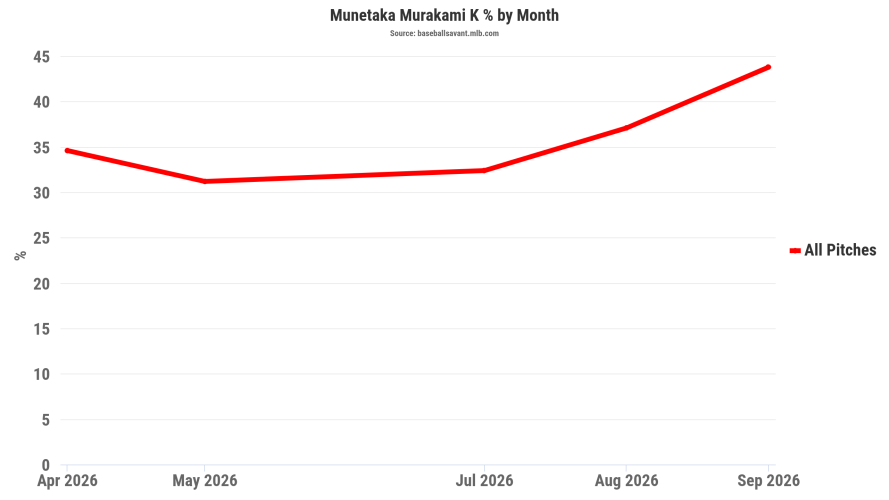
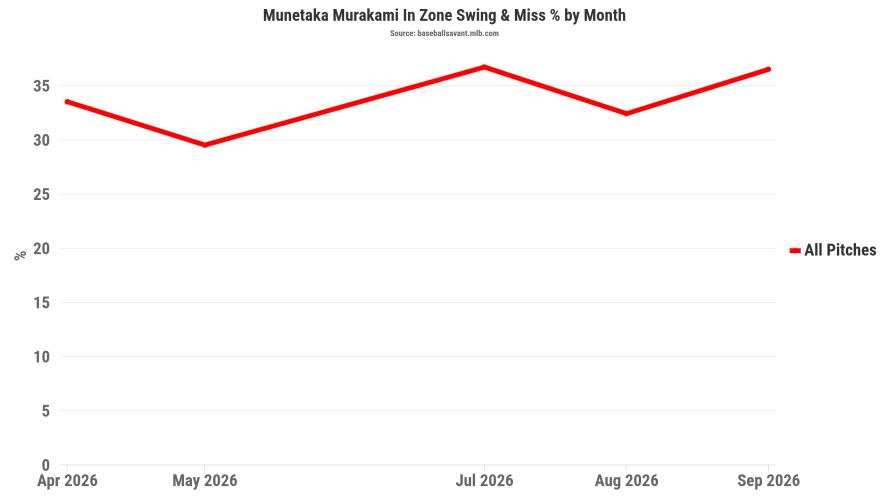
It was fun having Murakami on your roster when he hit 20 home runs with a .240 average and a manageable 32.5 percent strikeout rate before June, but not so much fun when he hit .181 with 15 home runs and a 37.8 percent strikeout rate from June 1st until the end of the season. That latter rate is Davis and Gallo territory, and not the good kind. Murakami could easily head down that same list of endgame power options if the swing and miss in his approach does not decline. This was Matt Wallner heading into 2026 after he hit 22 homers with a .202 batting average despite a career-best 29.1 percent strikeout rate in 2025. The big strikeout rate returned and he spent more time in St. Paul than he did in Minneapolis this season.
I personally do not want to end up in a roster build that requires me to roster either of these players, as there were few signs of overall improvement with either of them as the season went on, unless everyone in the league is aggressively fading this duo. It is clear they will have to hit 30 or more homers again to retain anything more than end-game value in any format. I would be stunned to see either player finish inside the top 250 in 2027 or return a double-digit earned auction value.
Conversely, two pitchers stand out on the 2026 final leaderboard because they found success despite low strikeout rates — Nick Martinez and Randy Vasquez:
| PITCHER | WINS | ERA | K% | FINAL | 12$ | 15$ |
|---|---|---|---|---|---|---|
| Nick Martinez | 15 | 3.10 | 15.1% | 91 | $14 | $16 |
| Randy Vasquez | 10 | 3.90 | 14.8% | 314 | -$3 | $0 |
These two were the only pitchers in 2026 to post a sub 4.00 ERA despite some of the lowest strikeout rates in baseball for pitchers with at leat 100 innings of work. There are just 15 instances of a sub-4.00 ERA for pitchers with a sub-16 percent strikeout rate since 2016, and Vasquez has now done it in consecutive seasons. He remained end-game streaming material for 2026, but the 10 wins pushed up his final overall ranking. He should remain a reserve option or draft-and-hold depth for 2027, but Martinez is the bigger case here as he hits the open market once again for free agency.
Martinez just set the new record for the lowest ERA with a sub-16 percent strikeout rate over the past 10 seasons, surpassing Andre Pallante's 3.17 ERA with a 16 percent strikeout rate back in 2022. Vasquez, Zach Davies and Jose Urena are the only three players to have multiple seasons below a 4.00 ERA despite a low strikeout rate:
| PITCHER | SEASON | ERA | K% |
|---|---|---|---|
| Nick Martinez | 2026 | 3.10 | 15.1 |
| Andre Pallante | 2022 | 3.17 | 16.0 |
| Johnny Cueto | 2022 | 3.35 | 15.7 |
| Andrew Cashner | 2017 | 3.40 | 12.2 |
| Zach Davies | 2019 | 3.55 | 15.2 |
| Parker Bridwell | 2017 | 3.64 | 14.8 |
| Zack Greinke | 2022 | 3.68 | 12.5 |
| Colby Lewis | 2016 | 3.71 | 15.5 |
| Jose Urena | 2024 | 3.80 | 15.1 |
| Jose Urena | 2017 | 3.82 | 15.6 |
| Randy Vasquez | 2025 | 3.84 | 13.7 |
| Brett Anderson | 2019 | 3.89 | 12.1 |
| Randy Vasquez | 2026 | 3.90 | 14.8 |
| Zach Davies | 2017 | 3.90 | 15.2 |
| Jose Quintana | 2025 | 3.96 | 16.0 |
Martinez took to the Rays' home environment and pitching support like a kid in a candy store as his 3.10 ERA tied his previous career best from 2024 (set in a more hostile Great American Ballpark). Martinez used an increasing amount of changeups, particularly to righties, to keep hitters off balance. He walked 26 batters in 180 innings of work and had multiple walks in just 5 of his 31 starts. The .265 batting average on balls in play was a new career low, but not too far below his .279 career mark or the fact his BABIP has been between .265 and .275 in each of the past three seasons.
Some might be quick to dismiss the performance as taking advantage of Tropicana Field, but the fact is Martinez was more effective on the road. He had a 2.38 ERA with a .232 oppoonents' batting average on the road compared to a 3.90 ERA and a .267 opponents' average at home, where he also permitted 14 of his 22 home runs on the season. Home/road splits have as much year-to-year stickiness as gum found in an old pack of baseball cards, but it has been the driver both seasons in which Martinez has posted a sub-4.00 ERA. The 2025 season saw this split go awry for Martinez, but he has historically pitched better on the road in recent years despite calling Petco, Great American and Tropicana his home stadiums.
Martinez has now had an ERA below 3.50 in four of the past five seasons while his strikeout rate has declined each of the past four seasons, going from 23 percent in 2023 to 20.4 percent in 2024, 17.0 percent in 2025, and 15.1 percent in 2026. This game of statistical tightrope-walking works until it does not. Martinez is 36 years old and survives on excelling with his command and keeping batters off balance. Yet father time comes for all such pitchers and the game of cat and mouse eventually end. Zack Greinke, for all his greatness, was this guy until he was not. As late at 2022 in his age-38 season, he had a sub 4.00 ERA despite a 12.5 percent strikeout rate, but he came back in 2023 and pitched to a 5.06 ERA and called it a career.
Martinez would need to hope for a change of scenery and favorable schedule to find more strikeouts, but his game is more about generating weak contact more than strikeouts. He cares not about your fantasy team's strikeout total but has posted double-digit wins in each of the past three seasons with good WHIPs in all three and solid ERAs in two of the three seasons. Martinez is likely to see some ERA correction in 2027, as the 3.97 xERA and the 4.47 xFIP show from this current season, but it will not be due to his home park or a BABIP outlier. He, in fact, has done both things before in worse environments, so it is tough to be so dismissive of what he accomplished this season despite the lack of strikeouts. I am not as afraid of rostering him as I am the other three, but you must account for the dearth of strikeouts. I enjoyed Martinez in many leagues this season, but the lack of strikeouts was particurly painful in AL Tout Wars, where I finished second in wins and WHIP, first in ERA, but sixth in strikeouts. 40 more strikeouts on the season would have won me the league.
Unicorns are fun when you find them in a season, but counting on them for too long can get you into a rough area of fantasyland from which you may not recover.
