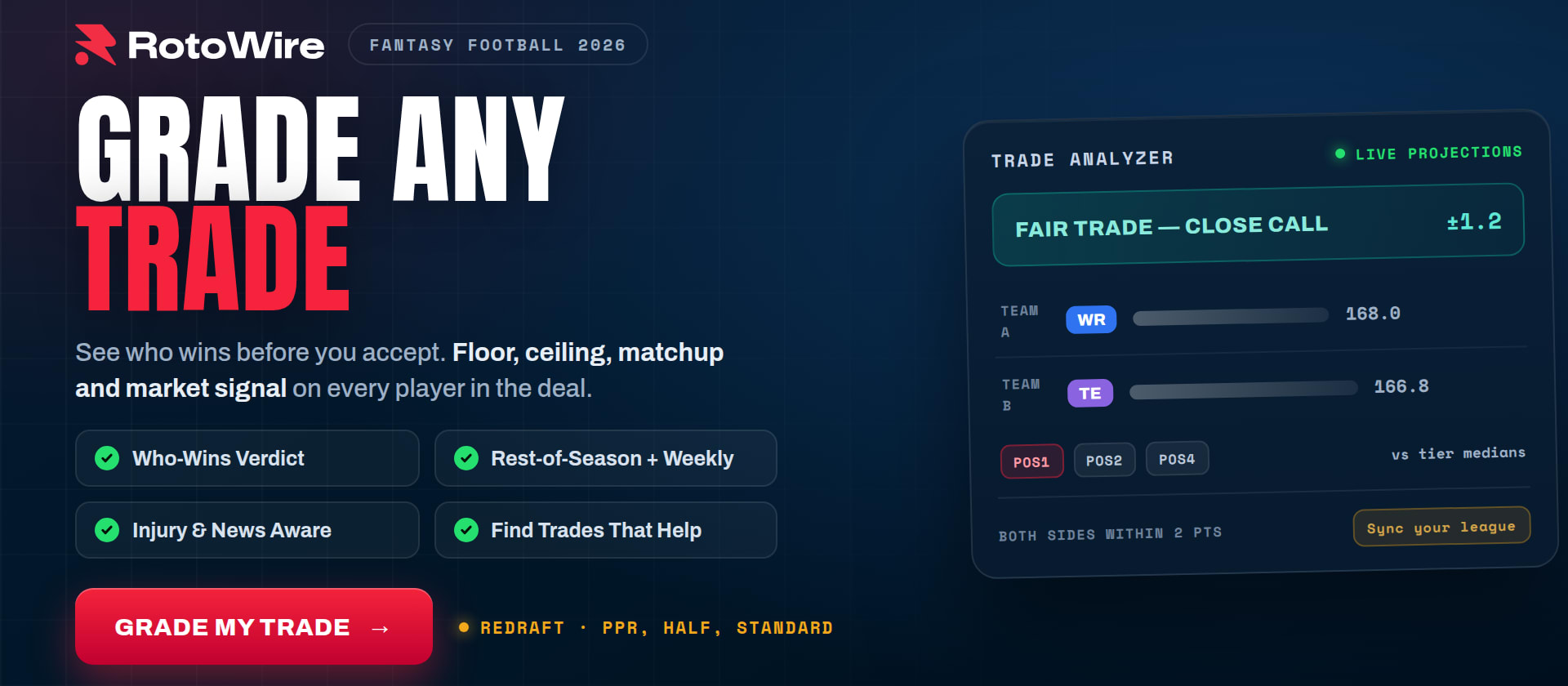


The RotoWire Fantasy Football Trade Analyzer is a trade calculator that shows how a proposed trade changes each team's outlook for your exact league, then grades the deal. It projects every player two ways — rest-of-season and the upcoming week, each with a floor and a ceiling — and lets you open a full breakdown of the numbers behind each side.
Projections, rankings, injuries, and news come from RotoWire, with optional live betting-market data. This trade tool is built for Sleeper redraft leagues but if you're not on Sleeper you can manually evaluate a trade or upload rosters.
Fantasy Football Trade Analyzer For Every Format
Weekly Fantasy Football Trade Values
Fantasy Football Weekly Transaction Trends
Every week, thousands of managers make the same handful of decisions — who to start, who to trade for, who to stash — and the patterns in those decisions say a lot about where a player's value really sits. The League Trends tool below aggregates roster activity across live synced Sleeper leagues to show what fantasy managers are actually doing right now: who the winning teams are leaning on, which players are being moved, and which combos keep showing up together. It's not a projection — it's a read on the market.
What each view tells you
- On Winning Teams — players who show up more on teams with winning season records (.600+) than on losing ones (.400 or worse). This is the most interesting lens and the one to read carefully: it's a correlation, not a cause — it reflects roster quality plus some schedule luck, so treat it as who the winners tend to have, not a formula for winning. Tap a player for the breakdown.
- Most Traded — the players changing hands most this season: your active buy-low and sell-high candidates. Tap any player to see each individual trade broken down.
- Together — the players most often rostered on the same team, surfacing the popular stacks and combos managers are building — each with the win rate of the teams that roster both, so you can see which combos are actually landing on winners.
How to analyze a fantasy football trade
You can analyze a trade against your real league or set one up by hand:
- Sync a Sleeper league. Paste your league ID — the number in the URL at sleeper.com/leagues/ID/… — and the tool pulls every team's roster, scoring, and lineup settings. Analysis is roster-aware, so it weighs the trade against the starters and bench each team actually has.
- Enter it manually. Choose scoring (PPR, Half-PPR, or Standard) and format (1-QB or Superflex/2-QB), then add players by name or paste a roster from ESPN, Yahoo, CBS, or NFL. Manual mode compares the players you trade against a startable replacement in your scoring; syncing a league gives fuller, roster-aware analysis.
- Get the RotoWire Fantasy Pass and sync with any of the most popular fantasy football platforms and get access to the most comprehensive (yet easy to use) fantasy football trade tools that you have ever seen.
How the trade calculator grades your deal
Each analysis opens with a headline judgment: a fair deal (a close call), a lean to one side, or a lopsided trade. It names the team that comes out ahead and the margin in rest-of-season points, and adds a confidence label indicating how clear the edge is. Three-team trades are graded the same way.
Disclaimer: fantasy football trades are famously difficult to evaluate because anyone that's ever played fantasy football before knows there is a wide range of opinions on any given player or any specific move. This essentially a math equasion that will help you ground reality and create a compelling offer that your league mate will accept.
Not a math guy, just a guy's guy? No problem, check out RotoWire's consensus expert rankings from each of these guys:


 Theo Gremminger
See Theo's personal rankings, tiers, and draft targets.
View Rankings
RotoWire Analyst
 Ian Hartitz
See Ian's personal rankings, tiers, and draft targets.
View Rankings
RotoWire Analyst
 Jagger May
See Jagger's personal rankings, tiers, and draft targets.
View Rankings
RotoWire Analyst
 Jim Coventry
See Jim's personal rankings, tiers, and draft targets.
View Rankings
RotoWire Analyst
 Jeff Erickson
See Jeff's personal rankings, tiers, and draft targets.
View Rankings
RotoWire Analyst
 Jerry Donabedian
See Jerry's personal rankings, tiers, and draft targets.
View Rankings
Fantasy football trade value: rest-of-season and weekly projections
Every player and team is projected two ways: rest-of-season (total points remaining, plus a per-game figure) and the upcoming week. Each projection carries a floor and a ceiling, so you see both the expected outcome and the realistic range around it. A summary table lists, for each player in the deal, the consensus rank, bye week, rest-of-season points and floor–ceiling, and weekly points and floor–ceiling.
Playoff-odds impact in synced leagues
In a synced league of four or more teams, the tool estimates each team's playoff odds before and after the trade. This is a points-based simulation that plays each team's weekly optimal lineup out to the end of the season; it does not model your exact head-to-head schedule.
Player breakdowns: projections, matchup, and usage
Tap any player to expand a detail card. Alongside the median weekly projection, floor, ceiling, and rest-of-season total, each card shows:
- Projected weekly stat line — passing, rushing, and receiving output.
- Advanced metrics against positional tiers — the player's 2026 rates next to 2025, and where they rank versus the top, mid, and back-end starters at the position.
- Matchup — the upcoming opponent's defense-versus-position strength, and home or away.
- Usage — snap alignment (slot, wide, tight, and backfield share) for wide receivers and running backs, and route rate for tight ends.
- Injury status and latest news — the current designation and the most recent note on the player.
Injuries, rankings, and byes
Consensus rankings and bye weeks appear next to each player. An injury designation widens that player's floor rather than forcing a binary in-or-out call, and the result flags when a traded-away starter carries injury risk.
Blend betting markets into the projection
Turn on "Blend betting markets" to fold near-term sportsbook data into the weekly projection. The tool factors in a player's team implied total and anytime-touchdown probability, drawn from a consensus five-book median or a specific book (DraftKings, FanDuel, BetMGM, Caesars, or theScore).
The market signal is shown next to the projection, so you can see what moved it.
Find trades that help your team
In a synced Sleeper league, the "Find trades that help me" button scans every rival roster for one-for-one swaps that raise your team's rest-of-season starting-lineup projection. Two rules keep the suggestions realistic: a deal only appears if it meaningfully improves your lineup, and offers that would gut the other team are filtered out — so what you see are trades a rival might actually accept, not lopsided robbery.
Results are ranked, with win-win deals — where both teams come out ahead on rest-of-season points — flagged. Each row shows the player you send, the player you get, your projected rest-of-season gain, and the other team's change. Tap any suggestion to load it into the builder and open the full breakdown. The feature reads your league's rosters, so it is available in synced leagues only.
Even out a lopsided trade
For two-team trades, the analyzer can suggest a sweetener to bring a lopsided offer closer to fair, so you can find the piece that balances a deal without giving up too much.
Where the data comes from
Trades are graded based on RotoWire's fantasy football projections, rankings, injuries, and news; betting-market data comes from regulated online sportsbooks and prediction markets. Player data is refreshed weekly through the season. The analyzer covers redraft leagues and evaluates current-season value — it does not price dynasty assets or draft picks.
More Fantasy Football Trade Resources: