
Jalen Coker, A.J. Brown and De'Zhaun Stribling
Ankle injuries dominated the Week 1 NFL injury headlines, as three wideouts suffered ankle sprains. Yet each case was a different injury, demonstrating the kaleidoscope of possibilities that comes with an ankle sprain.
The true ankle joint or talocrural joint is a basic hinged articulation formed by the two lower leg bones, the tibia and the fibula, and the talus of the foot. The talus sits beneath the distal ends of the bones, allowing for up-and-down motion of the foot. Ligaments anchor to both the tibia and the fibula, stabilizing the joint.
A "common" lateral ankle sprain occurs when the foot is forced inward, stretching the three stabilizing ligaments on the outside aspect of the foot. Like all sprains, the severity of the sprain is classified based on the amount of damage accrued by the involved ligament(s). A mild sprain or Grade 1 sprain occurs when the damage is minimal and isolated to microfibers. A Grade 2 sprain is also known as a partial tear and is marked by tearing of the fibers that make up the ligament. Anything graded higher is considered a complete tear or rupture and often requires surgical intervention.
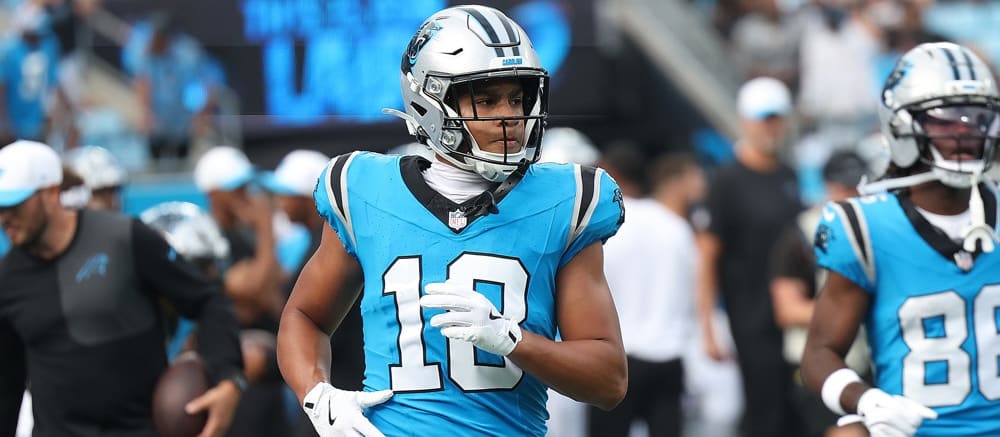
In Carolina another key NFL injury occurred, as Coker suffered what appears to be a mild lateral ankle sprain in the team's Week 1 loss to the Bears. He said he "just rolled the ankle a little bit" in the early aspect of the game and was seen wearing
Jalen Coker, A.J. Brown and De'Zhaun Stribling
Ankle injuries dominated the Week 1 NFL injury headlines, as three wideouts suffered ankle sprains. Yet each case was a different injury, demonstrating the kaleidoscope of possibilities that comes with an ankle sprain.
The true ankle joint or talocrural joint is a basic hinged articulation formed by the two lower leg bones, the tibia and the fibula, and the talus of the foot. The talus sits beneath the distal ends of the bones, allowing for up-and-down motion of the foot. Ligaments anchor to both the tibia and the fibula, stabilizing the joint.
A "common" lateral ankle sprain occurs when the foot is forced inward, stretching the three stabilizing ligaments on the outside aspect of the foot. Like all sprains, the severity of the sprain is classified based on the amount of damage accrued by the involved ligament(s). A mild sprain or Grade 1 sprain occurs when the damage is minimal and isolated to microfibers. A Grade 2 sprain is also known as a partial tear and is marked by tearing of the fibers that make up the ligament. Anything graded higher is considered a complete tear or rupture and often requires surgical intervention.
In Carolina another key NFL injury occurred, as Coker suffered what appears to be a mild lateral ankle sprain in the team's Week 1 loss to the Bears. He said he "just rolled the ankle a little bit" in the early aspect of the game and was seen wearing a protective walking boot on Monday. Coker said the boot was precautionary and that he doesn't expect to miss any time. The third-year wideout hauled in eight receptions on nine targets in Week 1 to finish with 138 receiving yards and two touchdowns. Look for him to be a top waiver wire target despite the surprise injury designation.
Sprains of the medial ankle are much more uncommon than the lateral ankle sprain, largely due to the shape of the ankle and the strength of the supportive structures fortifying the area. Here, the ligaments form a triangle of connective tissue known as the deltoid ligament that prevents excessive inward movement or eversion. The deltoid ligament is so strong that a piece of bone will frequently break away from the main bone before a high-grade sprain occurs. As a result, injuries here often take longer to heal than a lateral ankle sprain with a similar grade.
The 49ers rookie wideout suffered a deltoid sprain in the team's Week 1 win over the Rams. Stribling is expected to miss at least one month with the ailment, and surgery has not been ruled out. He is slated for further evaluation, and a trip to the injured reserve may be required.
The final variety of ankle sprain involves a joint known as the distal tibiofibular (tibfib) joint located at the bottom of the leg, where the tibia and fibula sit atop the talus. A durable ligament known as the interosseous ligament spans across the distal tibfib joint to connect the two lower leg bones. Two more ligaments, the anterior and posterior tibiofibular ligaments, further assist in stabilizing the ankle mortise. An injury to any of these ligaments is referred to as a "high ankle" or syndesmotic sprain and is often accompanied by a higher degree of instability. Surgery is often an option to address a high ankle sprain and comes with a relatively quick recovery.
New England's A.J. Brown has already been placed on the IR after suffering a high ankle sprain in Week 1 but is not expected to undergo surgery. As a result, he will miss at least four weeks, though the expectation is he will miss closer to six weeks. Romeo Doubs, Mack Hollins, DeMario Douglas and Kyle Williams all move up the Patriots' depth chart with Brown out.
Turf Burns
Brock Bowers: The Raiders are calling Bowers "day-to-day" despite the tight end undergoing knee surgery prior to Week 1. The procedure was a partial meniscectomy, meaning the damage area of his meniscus was removed and not repaired. With the problematic tissue excised, recovery focuses on treating any associated symptoms and regaining any range of motion or strength deficits. Athletes often bounce back in four to six weeks, but it is clear Bowers is already seeing an improvement. Watch his status in the week ahead, but there is reason to believe he will be back quicker than expected.
Sam Darnold: Darnold suffered a hip injury that ended his Week 1 after just five offensive snaps. Imaging revealed what is believed to be a glute tendon injury near the area where the muscle attaches to the hip. The team has ruled him out for Week 2 but will determine a long-term recovery window after seeing how he responds to treatment. Darnold is also expected to continue seeking medical advice from specialists as he works through this unique injury. Drew Lock will take over for Seattle, though his fantasy ceiling is limited.
Falcons Quarterbacks: With Michael Penix still working his way back from knee surgery, Tua Tagovailoa was named the starter in Atlanta. However, Tua suffered an oblique strain in the buildup to Week 1 and was ruled out. Oblique strains often result in limited trunk rotation and as a result are particularly problematic for quarterbacks. Backup Cooper Rush was also limited by back spasms prior to the loss to the Steelers but managed to get the start. After Rush's ineffective performance in which he completed 12 of 22 passes for 143 yards, a touchdown and two interceptions, the starting quarterback spot remains in flux. However, health will remain the most important factor, and it remains to be seen who will be ready to go for the team's home opener against the Panthers. Downgrade all Falcons fantasy players until the situation stabilizes.
Myles Garrett: The Rams defensive end is expected to undergo arthroscopic knee surgery after he struggled in Week 1. His knee has been an issue since early August, and the hope is the procedure will clean out the troublesome area. It is unclear if the problem is scar tissue or a cartilage issue, but the hope is he will be ready to return from the IR when first eligible.
Ladd McConkey: The Chargers wide receiver is considered day-to-day after suffering an undisclosed rib injury in Week 1. The rib cage comprised 12 pairs of ribs, the 12 corresponding thoracic vertebrae and the sternum. The bony ribs and their cartilage attachments can become bruised or break following a direct blow. Most rib injuries are very difficult to manage, as simple everyday tasks like breathing can elicit pain. Football players can pad the area and use nerve blocks if they opt to play through the injury, but those methods aren't real treatments. Time remains the best course of action in most cases. Monitor McConkey's availability in the week's practices to get a better gauge on whether he will be available in Week 2 against the Raiders.
Kyler Murray: Murry suffered a scary concussion when he was hit early in the team's win over the Packers. As he was struck, Murray displayed the fencing response, a type of abnormal posturing used as an indicator of head trauma, particularly to the brain stem. If a player displays any abnormal posturing during a game, they are immediately disqualified from returning to play, per NFL rules. Murray must now complete the league's mandated concussion protocol before he will be permitted to return. The majority of quarterbacks to suffer concussions in recent seasons miss at least one game, with Drake Maye being the only notable exception. Look for Carson Wentz to be the primary signal caller for the Vikings in Week 2.
