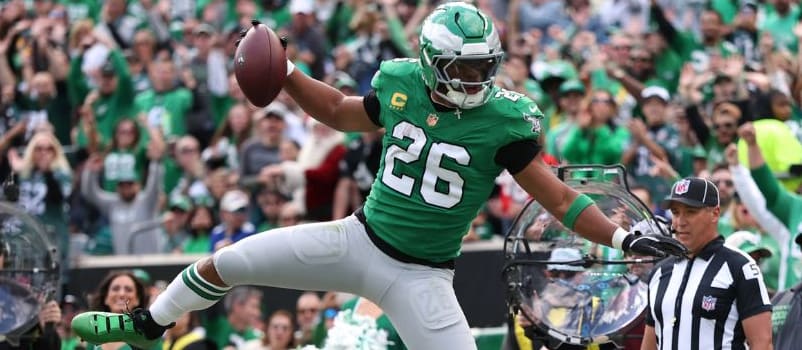

Seeing the dreaded red cross next to a player on your fantasy roster is disheartening, especially when the cause of the update is a lower extremity strain. Most seasoned fantasy veterans know these NFL injuries often linger and can impact the individual for the remainder of the season. Still, most people are unsure why these injuries are so fickle and can be so difficult to manage. To better answer this question, let's examine the body's natural healing response and how it works to address muscle strains.
The process begins immediately after the injury occurs when the body's initial clotting response is initiated and swelling occurs at the injury site. As this inflammatory phase continues, the proliferative phase starts and muscle repair begins. Proteins like collagen and elastin are used to fill in the gaps where the damage occurred. During the final phase, the developed scar tissue is gradually remodeled to restore the area to its original integrity.
Unfortunately, remodeling often occurs in a disorganized fashion. I have previously likened the process to a construction crew repairing a pothole. Workers clear away debris, reshape the hole, add fresh asphalt, and compact and seal the patch so it blends with the surrounding road. Even after the repair is complete, however, the patch can fail if traffic returns too soon or harsh weather disrupts the new surface.
The same goes for an athlete recovering from a lower extremity strain, as the scar tissue at the injury site behaves much like that road patch.
Seeing the dreaded red cross next to a player on your fantasy roster is disheartening, especially when the cause of the update is a lower extremity strain. Most seasoned fantasy veterans know these NFL injuries often linger and can impact the individual for the remainder of the season. Still, most people are unsure why these injuries are so fickle and can be so difficult to manage. To better answer this question, let's examine the body's natural healing response and how it works to address muscle strains.
The process begins immediately after the injury occurs when the body's initial clotting response is initiated and swelling occurs at the injury site. As this inflammatory phase continues, the proliferative phase starts and muscle repair begins. Proteins like collagen and elastin are used to fill in the gaps where the damage occurred. During the final phase, the developed scar tissue is gradually remodeled to restore the area to its original integrity.
Unfortunately, remodeling often occurs in a disorganized fashion. I have previously likened the process to a construction crew repairing a pothole. Workers clear away debris, reshape the hole, add fresh asphalt, and compact and seal the patch so it blends with the surrounding road. Even after the repair is complete, however, the patch can fail if traffic returns too soon or harsh weather disrupts the new surface.
The same goes for an athlete recovering from a lower extremity strain, as the scar tissue at the injury site behaves much like that road patch. Although the damage has been filled in and fixed, the new tissue is initially weaker than healthy muscle and may fail if the athlete returns too soon. This is complicated by the fact that the injured individual may present as pain-free with full range of motion even though they remain in the final stages of the healing process. If the freshly formed muscle tissue is pushed past its lower-than-normal failure point, a recurrence or new injury can occur, and the entire process must start again.
So why does this matter for might fantasy football team? Well, with NFL injuries this year, we have seen a high number of lower extremity strains (calf, hamstring, groin) in the first five weeks of the season. It doesn't appear to be significantly higher than years past, but these ailments are ravaging rosters league-wide. Teams have been quick to call these injured players "week-to-week," a particularly frustrating label but one that makes more sense when you understand the delicate process these individuals must now face. Furthermore, teams appear more willing to hold players out for a longer portion on the front end, in hopes of avoiding a secondary injury or recurrence. The approach also helps improve the chances that the player misses less cumulative time throughout the season. As a result, I'm advising fantasy managers to remain patient and trust the (healing) process.
Turf Burns
Saquon Barkley: Barkley is targeting a Week 6 return from his hamstring strain, and the team is "hopeful" he will be available versus the Panthers. He will need to log multiple practices before I would start him without reservations, but injuries up and down the depth chart might force Philadelphia's hand. Tank Bigsby is on IR after undergoing core muscle surgery, and backup Will Shipley suffered a partial tear of the plantar fascia in his foot. Dameon Pierce and Carson Steele will be called into action if either player sits against Carolina.
Lamar Jackson: The former MVP is making progress in his recovery from an ankle sprain. Coach Jesse Minter said his quarterback is "definitely doing better" and has not been ruled out for Week 6. Jackson's availability will depend on him continuing in his treatment protocol, which will include recording real practice reps. Any positive momentum should be considered a win, and those invested here will have to hope he keeps moving in the right direction in the week ahead.
CeeDee Lamb: The Cowboys receiver will benefit from extended rest following the team's Thursday night loss to the Buccaneers. Lamb is reportedly dealing with a twice-bruised quadriceps muscle. While not as severe as a strain, quad contusions have their own set of issues to consider. Thigh contusions can develop into a more serious condition known as myositis ossificans if improperly treated or not provided adequate time to heal in between repeated blows. In myositis ossificans, small calcium formations similar to bone may develop in the damaged tissue of the muscle, causing pain and functional limitations. Lamb should be fine moving forward, but don't make an immediate assumption on his availability just because the word contusion sounds insignificant.
Kyle Monangai: The Bears running back suffered a thumb injury and a big toe injury in Week 4. The foot injury is the more worrisome of the ailments, as the injury has been diagnosed as turf toe. Turf toe is used to describe a hyperextension of the big toe, which often sprains the connective tissue around the joint. The injury is very painful and limiting, and can linger, even if the Bears work to fortify Monangai's cleats. I expect Monangai to miss additional time recovering, and he will likely be eased back into the rotation when he is cleared to return. D'Andre Swift remains the feature back in Chicago, despite minor injuries of his own.
David Montgomery: The Texans are calling Montgomery "week-to-week" after he suffered a groin strain against the Titans. The injury paves the way for Woody Marks to take over in the Texans backfield with Dare Ogunbowale moving up the depth chart. Houston has a bye week in Week 8 that should help minimize the time lost by Montgomery.
Michael Penix: The Falcons quarterback was unable to finish his team's OT loss to the Ravens after suffering a rib injury. Rib injuries are often very painful, especially if they involve the costal cartilage. Penix's status likely will come down to pain-tolerance, making this probably a game-time decision.
Deebo Samuel: The veteran wide receiver suffered a hamstring strain against Seattle and is expected to miss "at least a couple weeks." The 49ers have a bye week in Week 8, so it seems likely Samuel is out until at least Week 9. San Francisco will lean on Mike Evans, Brandin Cooks and Jacob Cowing even more with Samuel sidelined.
Jaxon Smith-Njigba: The Seattle wideout was estimated as a limited participant in Monday's practice after suffering an ankle injury against San Francisco. The Seahawks face a short week of preparation as they are playing on Thursday, so the decision could be precautionary more than anything. The injury reportedly occurred in the first half, and JSN was still able to finish the game. This appears to be a mild ankle sprain, and Smith-Njigba is simply too good to consider benching, even if he is less than 100 percent.
Caleb Williams: Williams is another one of the balky hamstrings to monitor. By all accounts he is nearing a return, but the Bears remain noncommittal to start the week. Remember, the quarterback suffered a Grade 2 strain, meaning fibers of the muscle were partially torn. As discussed, healing for injuries of this severity takes time, and the Bears will play the long game with the health of their franchise quarterback.
