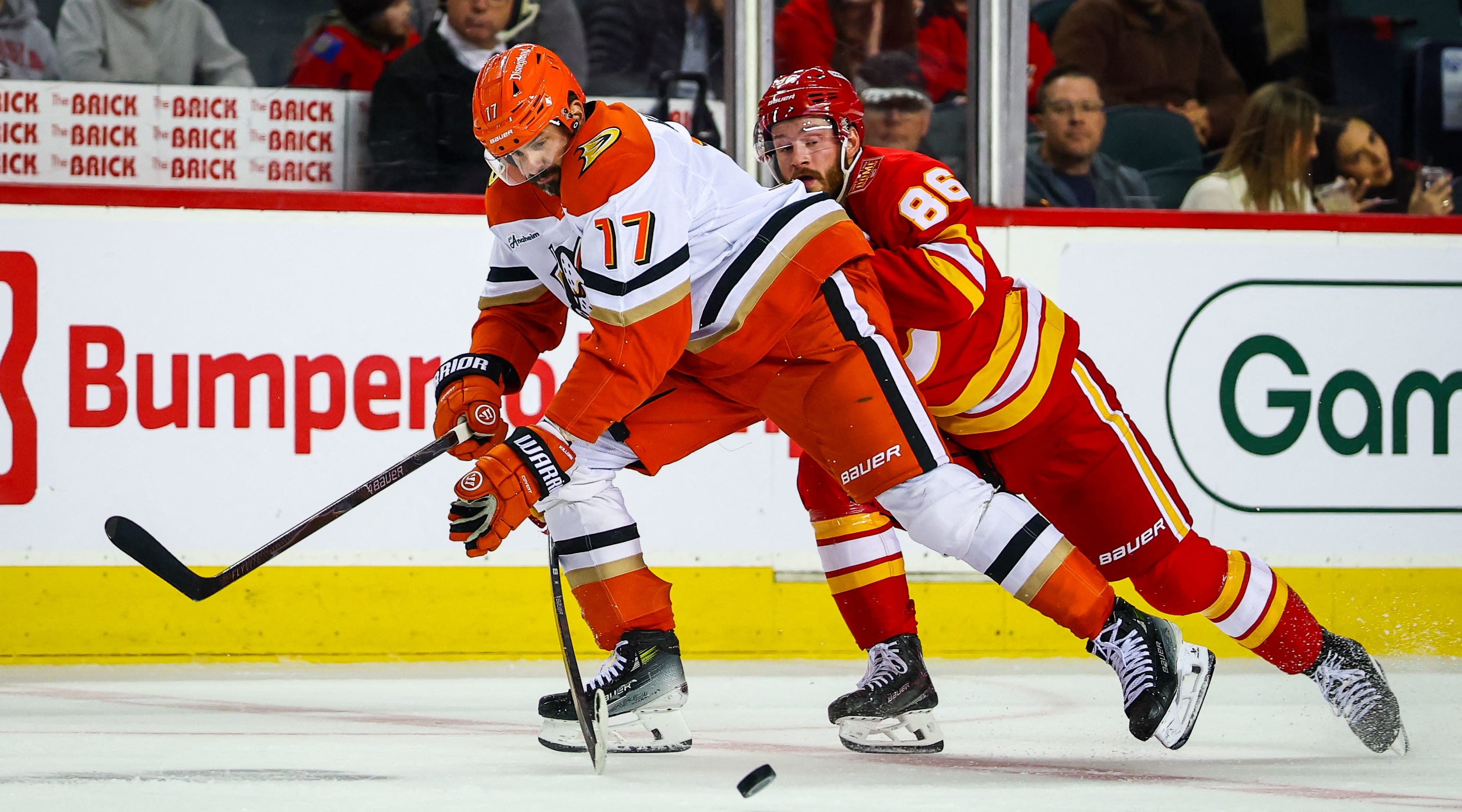
Poisson-based goal probability, shrinkage-adjusted scoring rates, and a live matchup edge for every anytime goal scorer bet on tonight's NHL slate -- built and maintained by RotoWire.
What Is an Anytime Goal Scorer Bet?
An anytime goal scorer (ATG) bet pays out if a specific player scores at any point during regulation or overtime -- first goal, last goal, or anywhere in between. You don't need to predict when the goal comes, only that it happens. It's the most straightforward goal-scoring prop in hockey betting, which is also why sportsbooks price it aggressively on star players and why an independent model matters most on the names further down the lineup. See the latest NHL player props for the 2026-27 season from RotoWire here as well.
Anytime goal scorer markets exist across most sports, but NHL pricing behaves differently than soccer's version of the same bet because of two things unique to hockey: five skaters get regular power-play time on every roster, and starting goaltenders vary enormously in how many high-danger looks they allow by position. The Lamp Lab model is built around exactly those two levers.
How the Lamp Lab NHL Betting Model Works
Lamp Lab starts with each skater's real scoring rate this season across 5-on-5, power play, and penalty-kill situations, blended with their underlying expected-goals rate so a hot or cold streak doesn't swing the number on a small sample. That blended rate becomes a Poisson lambda -- the expected number of goals for that player in a game with league-average opposition.
From there, the model adjusts lambda up or down based on tonight's actual opponent: how many goals that opponent's real 2025-26 season data shows they allow per game at the player's position, and a separate multiplier for the opposing starting goaltender. Both adjustments are dampened 50% toward neutral so one noisy defensive split can't overwhelm a full season of scoring data. The result converts to a probability using the standard Poisson formula:
P(goal ≥ 1) = 1 − e^(−λ)
where λ (lambda) is the matchup-adjusted expected goals for that player, tonight.
That probability is what populates the ATG% column on the board above. Nothing in that number comes from betting lines -- the model prices the player first, then compares that price to the market.
How to Read the Lamp Lab Board
● ATG% -- the model's own probability that the player scores tonight, from the Poisson calculation above. This is Lamp Lab's number, not the sportsbook's.
● Fair Odds -- ATG% converted to American odds. This is what the bet would pay if the model's number were the only thing setting the price.
● DK -- the live DraftKings anytime goal scorer price for that player, pulled directly from the book.
● Edge -- the gap between the model's implied probability and DraftKings' implied probability, in percentage points. Positive edge means the model sees more scoring probability than the book is pricing in.
Edge is a signal, not a guarantee. A 5% edge on a bottom-six forward with 15 games played carries far more uncertainty than a 5% edge on a full-season top-line regular -- check games played and role before betting size into any single number.
Filters: PP1, Hot, Due, Opp on B2B, Easy Matchup
● PP1 -- the player is on that team's confirmed top power-play unit tonight, sourced from real lineup data, not assumed by roster status.
● Opp on B2B -- tonight's opponent played last night and is on the second half of a back-to-back, a real scheduling factor tied to their actual game log, not a model input.
● Hot -- the player scored at an above-average rate over their last 10 games of real game logs relative to their season pace. This is a reference signal only; it is not built into the ATG% number.
● Due -- the player's actual goals over their last 10 games trailed their real expected-goals total by a wide margin, a regression signal — also reference-only, not baked into the model.
● Easy Matchup / High Total -- flags a favorable defensive matchup or a high game total (6+), both drawn from real matchup and betting-market data.
Want more NHL insight at the begining of the season? Have fun with RotoWire's Most Hated Team in every state and Canadian province.
Methodology and Data Sources
Every number on the board traces to a named source:
● Scoring rates and game logs -- MoneyPuck, current NHL season
● Matchup and goaltender multipliers -- NHL Stats API, real season-to-date splits by team and position
● Lineups, power-play units, and injury status -- RotoWire's own reporting and DailyFaceOff
● Live odds -- DraftKings, refreshed automatically throughout the day
Roster and trade corrections are applied by hand when a player's team in the underlying data lags a real trade -- every correction is dated and sourced, never guessed. Where the model can't build a real number for a player -- no games played yet this season, for example -- that player is left off the board rather than estimated.
Frequently Asked Questions
What does "anytime goal scorer" mean?
It means the bet pays out if the named player scores a goal at any point during the game -- no need to call the exact time or whether it's the game-winner. Overtime goals in games that reach OT typically count; shootout goals do not, since a shootout goal isn't a game goal under NHL scoring rules.
Do shootout goals count as an anytime goal scorer?
No. Shootout results decide the game outcome and the extra point in the standings, but the shootout-winning goal is not recorded as a game goal, so it does not settle an anytime goal scorer bet. Always confirm the settlement rules on your specific sportsbook before betting, since wording can vary slightly by book.
How much do I win if I bet $100 on a moneyline?
It depends on the odds. Positive American odds (like +200) show what a $100 bet wins: a +200 bet returns $200 in profit on $100 risked, plus your original stake back. Negative odds (like -150) show what you'd need to risk to win $100: a -150 bet requires $150 to win $100 in profit.
What does +200 mean in odds?
+200 is American odds format for an underdog-priced bet. A $100 wager at +200 profits $200 if it wins (a $300 total return). The bigger the plus number, the less likely the bookmaker considers that outcome -- and the bigger the payout if it hits.
Do anytime goal scorer odds vary by sportsbook?
Yes, often by a meaningful amount on the same player and the same game. Lamp Lab prices every player against DraftKings specifically, for consistency -- that's the one price shown as "DK" and "Edge" on the board above. If you use a different book, treat DraftKings' line as a reference point and expect other sportsbooks to price the same player somewhat differently based on their own liability and betting action.
About This Model
Lamp Lab is built and maintained by RotoWire's data team. The board refreshes automatically multiple times per day as lineups, injuries, and odds change, and the underlying model -- the shrinkage formula, the matchup dampening, the data sources above -- is fixed before the season starts and is not adjusted after the fact to fit a particular night's results. Every figure on the board is computed from the named sources above; nothing is estimated or filled in. If you see a player missing who you'd expect to be there, it almost always means the model doesn't yet have enough real game data to build a number for them, rather than an oversight.