
This is the second of our annual two-part series detailing the top prospects in the NHL entering the 2026-27 season.
A couple of quick notes before we get started.
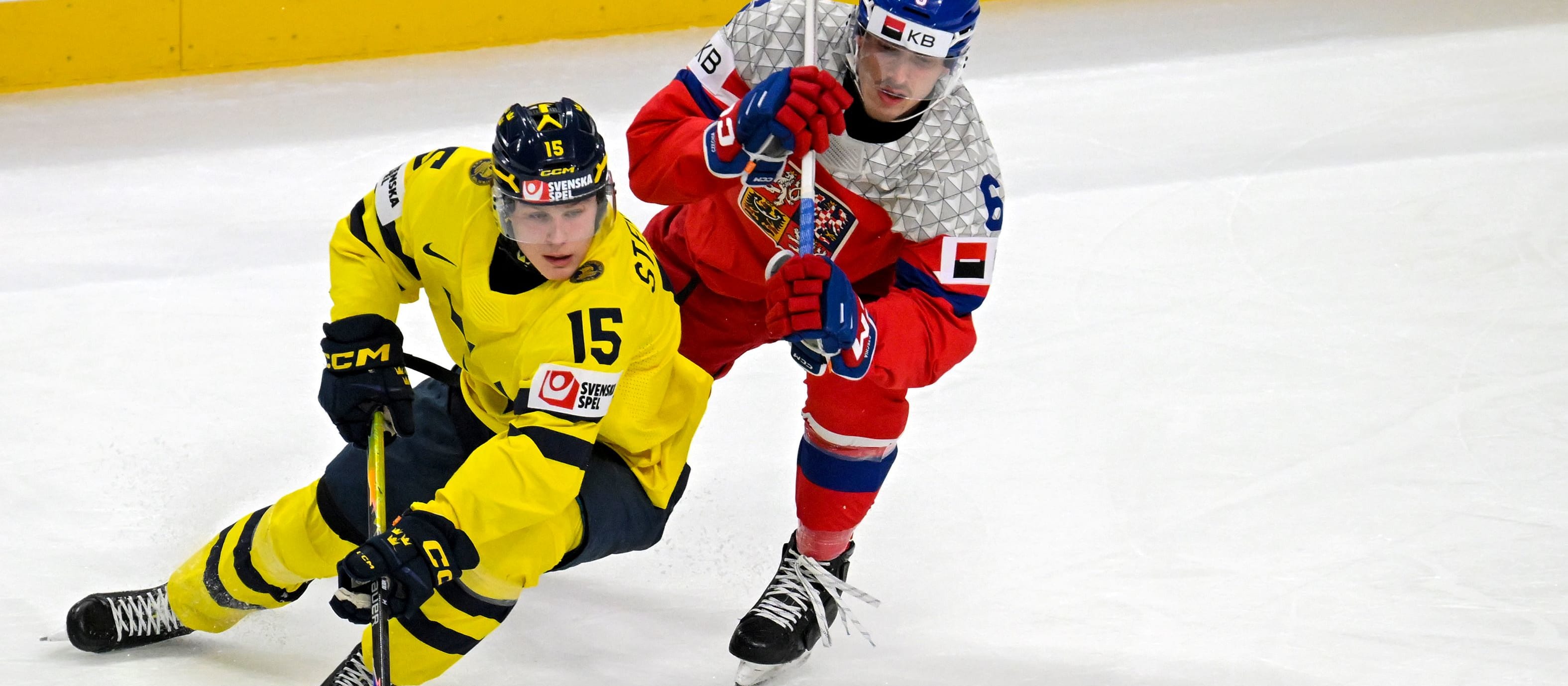
- I was very tempted to rank Ivar Stenberg second, but I ultimately felt what Porter Martone showed late last season during his initial NHL stint was enough to give him the edge.
In terms of tiers, I would rank the Top-50 as follows: 1-3, 4-13, 14-25, 26-38, 39-50
Don't forget to check out Part 1 - Players Ranked 51-150
Top Forward Prospects in the NHL Featuring Gavin McKenna, Porter Martone and Ivar Stenberg
1- Gavin McKenna (LW, TOR): McKenna joined Penn State this past season after multiple years with WHL Medicine Hat and closed with 15 goals and 51 points in 35 games. He was named Big 10 Rookie of the Year for his efforts. McKenna added 14 points in seven games at the World Juniors. At his best, McKenna was the most dynamic and talented player in the recently completed draft. The creativity and playmaking skills are exceptional. He's deadly with the man advantage and off the rush. That said, there are consistency issues here. You don't get the same level of production every single night, and his defensive effort is often poor. McKenna needs to win more battles and drive the net more frequently. He can become too perimeter-oriented at times, and that's a concern because it's much harder to find open ice at the NHL level as opposed
This is the second of our annual two-part series detailing the top prospects in the NHL entering the 2026-27 season.
A couple of quick notes before we get started.
- I was very tempted to rank Ivar Stenberg second, but I ultimately felt what Porter Martone showed late last season during his initial NHL stint was enough to give him the edge.
In terms of tiers, I would rank the Top-50 as follows: 1-3, 4-13, 14-25, 26-38, 39-50
Don't forget to check out Part 1 - Players Ranked 51-150
Top Forward Prospects in the NHL Featuring Gavin McKenna, Porter Martone and Ivar Stenberg
1- Gavin McKenna (LW, TOR): McKenna joined Penn State this past season after multiple years with WHL Medicine Hat and closed with 15 goals and 51 points in 35 games. He was named Big 10 Rookie of the Year for his efforts. McKenna added 14 points in seven games at the World Juniors. At his best, McKenna was the most dynamic and talented player in the recently completed draft. The creativity and playmaking skills are exceptional. He's deadly with the man advantage and off the rush. That said, there are consistency issues here. You don't get the same level of production every single night, and his defensive effort is often poor. McKenna needs to win more battles and drive the net more frequently. He can become too perimeter-oriented at times, and that's a concern because it's much harder to find open ice at the NHL level as opposed to college. McKenna would have made a mockery of the WHL had he stayed there this past season. His decision to play college hockey was a smart one, and I do think he's made positive strides in some of the areas in which he struggles, but he's not a finished product by any means. Still, the upside is immense. He's going to open the upcoming season filling a top six role for Toronto and should be considered a leading candidate for the Calder Trophy as NHL Rookie of the Year.
2- Porter Martone (RW, PHI): Martone is fresh off a season in which he was an impact player no matter where he played. He scored 25 goals and 50 points in 35 games as a freshman at Michigan State, led the World Juniors in goals with six in seven games and then picked up ten points in nine games in a late-season stint with the Flyers. He added five points in ten games at the World Championship after the year ended. Martone's physical maturity at 6-foot-3 and 210 pounds certainly aided his seamless transition to the highest level, but he looked like a guy that had been in the league for a decade from the very start and that was not something I expected. Martone's skating isn't great, but everything else -- led by the hands, work ethic, and shot -- is borderline elite. I think he's surpassed Matvei Michkov as the most valuable asset in the Philadelphia organization.
3- Ivar Stenberg (LW, SJ): Stenberg made great strides in the SHL this past season, finishing with 33 points in 43 games, a year removed from a campaign in which he had three points in 25 games. Stenberg can play both wings and has a long history of dominating for Sweden on the international circuit. He's a complete offensive player. Stenberg has a cannon of a shot, is highly creative both with and without the puck, and has improved his compete level to the point he wins his fair share of physical battles every single night despite being 5-foot-11 and about 185 pounds. I'm all-in and was of the opinion Stenberg had the greatest combination of both floor and ceiling in the 2026 draft. There were rumblings that the Sharks were considering a defenseman at No. 2, but it never made any sense. Stenberg was always going to be the best available player at that spot. He should open the upcoming season in the San Jose lineup.
4- Chase Reid (D, SEA): Reid showed me enough throughout the course of last season to rank him as the No. 1 defender in his draft class, so obviously I thought he was a major steal at No. 7 overall to Seattle. He certainly had the highest upside of the group. He averaged north of a point per game (18 goals, 48 points in 45 games) in what was his first full OHL campaign. He was also excellent for Team USA at the World Juniors despite opening the tournament in a depth role. Reid has excellent hands and elite vision. He's creative and has ideal size (6-foot-2, 190 pounds), although his physical game is lacking. The biggest concern at this point is his in-zone defending. It's improved throughout his year-and-a-half in the CHL, but it's not a strength and probably never will be. The good news is that he has both the frame and length to continue to make strides in that area. The Kraken drafted Reid to create offense, run an NHL power-play, and put up points. Originally scheduled to join Michigan State in the fall of 2027, Reid will arrive on campus for the upcoming season.
5- James Hagens (C, BOS): To the surprise of exactly no one, Hagens was awesome in his second and final season at Boston College. He racked up 23 goals and 47 points in 34 games and was named a finalist for the Hobey Baker Award as college hockey's top player. He signed with the Bruins in late March and spent six games with AHL Providence before making his NHL debut. Hagens is an elite skater and supremely creative playmaker. He also plays hard despite his game lacking physicality. Hagens is a future center although I could see Boston breaking him in on the wing to put him in more advantageous situations during his rookie season. I suppose Hagens could open the upcoming campaign with AHL Providence although I think he's ready for NHL duty. The Long Island native is one of the league's very best prospects.
6- Anton Frondell (C, CHI): The No. 3 pick in the 2025 Draft, Frondell began last season in Sweden, totaling 20 goals and 28 points in 43 SHL games. He was named Best Forward at the World Juniors in helping the Swedes win the Gold Medal before arriving in North America in March, registering nine points in Chicago's final dozen games. A versatile weapon who can play both center and wing, Frondell is highly creative and equally responsible defensively. He's had issues with the pace of play in the past, although that didn't appear to be an issue in his brief NHL stint. While Frondell may not project as a dominant scorer at the highest level, I have difficulty envisioning a scenario in which he's not an impactful, top six two-way threat.
7- Cole Hutson (D, WSH): Hutson's scoring numbers were down in his second and final season at Boston University, but he still averaged upwards of a point-per-game (10 goals, 32 points in 35 games). He finished the year with the Capitals, posting a ridiculous ten points in his first 14 NHL games. Cole isn't as naturally creative as his brother Lane, but he's more physical, a better one-on-one defender and still possesses high-end hockey IQ. He's also a better skater which allows him to generate offense off the rush that Lane cannot. In the end, it's six of one and half a dozen of the other. Both brothers are elite young players. Cole will play the entirety of his first full NHL campaign at age 20.
8- Carson Carels (D, CGY): Carels was such an important piece for WHL Prince George this past season that he averaged close to 30 minutes per night when all was said and done. The result was 20 goals, 73 points, and a plus-23 rating in 58 appearances. I do think those offensive numbers are a bit misleading, and I don't think Carels is going to score anywhere near that clip in the NHL. That said, there's a ton to like here. I see no real weaknesses in Carels' game. He makes smart, firm decisions with the puck. He battles defensively and has some grit to his game. Offensively, Carels should get his fair share of secondary point production. He turned just 18 years of age a handful of days before the draft, and he's already played a bunch of high-level hockey, including getting some run for Canada at the World Juniors, albeit in a limited depth role. I think Carels is more floor than ceiling, but the floor is quite high. He's a good prospect. Carels is committed to the University of North Dakota for the 2026-27 season.
9- Michael Hage (C, MTL): Seemingly every team that has approached the Canadiens for a trade in the past 12 months asks for Hage and Montreal says no. And rightfully so. The 2024 No. 21 overall pick is fresh off a sophomore season at the University of Michigan which saw him produce 13 goals and 52 points in 39 games. Hage also led the World Juniors in scoring with 15 points in seven appearances. He has both the hands and speed to make highly creative plays with pace. Hage's play away from the puck and his willingness to engage in secondary battles will never be a strength, but he's slowly improving in both areas. If you think he can stay in the middle, that's an argument for having him ranked higher than I do. He could be a potentially dynamic winger if it comes to that. I expect Hage to be signed and in the Montreal lineup late this coming season.
10- Caleb Desnoyers (C, UTA): Desnoyers was the No. 1 pick in the 2023 QMJHL Draft and then went No. 4 overall to Utah in the 2025 NHL Draft. He had a predictably dominant draft-plus-one season with QMJHL Moncton, totaling 22 goals and 78 points in 45 games. I continue to maintain that much of Desnoyers' game is underappreciated. At 6-foot-2, he's an excellent athlete. He has terrific work habits in all three zones and always gets the most out of his offensive abilities because of his stellar hockey IQ. This is the case of the sum of the parts potentially resulting in the Mammoth having a future No. 1 center on their hands. There's virtually no chance Desnoyers doesn't develop into a productive NHL pivot, even if it isn't of the dynamic, point-producing variety.
11- Alberts Smits (D, NYR): A native of Latvia, Smits spent most of the past year playing in Finland, primarily with Jukurit's top team while also seeing time with their junior club. In addition, Smits played a handful of games in the top German league. The highlight of his season was the fact that Smits played for his home country at both the World Juniors and the Olympics. The fact that he looked quite good at the latter at age 18 against the best players in the world is remarkable. Smits possesses elite size (6-foot-3, 205 pounds), range, and plenty of smarts. He made all sorts of creative offensive plays at the lower levels, which would lead you to believe he should be able to put up points in the NHL down the road. His reads, both offensively and defensively, are questionable at times, but not to the point that I'm concerned. That will correct itself over time. Smits is supremely confident in his own abilities, and you can dream on a kid who has played so much high-level hockey at such a young age turning into almost anything. Smits was arguably the most NHL-ready player in the entire draft and he should challenge for a roster spot in training camp.
12- Ilya Protas (LW, WSH): There's a case to be made that no prospect in the league raised his stock more in the past 12 months than Protas. After torching the OHL for 124 points in 61 games in his lone season in the league two years ago, Ilya moved to the AHL last season and led the league in rookie scoring with 29 goals and 66 points in 69 games. He finished the year picking up four points in a four-game trial with Washington. Protas' scouting report is a carbon copy of that of his older brother and fellow Capitals teammate, Aliaksei. Both are extremely limited from a speed standpoint, but when you combine Ilya's size (6-foot-5, 225 pounds) with his hands and overall offensive awareness, you have a high-end prospect on your hands. Protas has passed every test placed before him with flying colors and I imagine he'll be an immediate producer upon his full-time NHL arrival in the fall.
13- Tij Iginla (C, UTA): After appearing in just 21 games two seasons ago due to a hip injury, Iginla made 48 appearances for WHL Kelowna this past year, racking up a hysterical 41 goals, 90 points, and plus-47 rating. He added eight points in seven games at the World Juniors. I've long maintained Iginla's greatest attribute is his shot. Like most pure goal scorers, he can shoot through and around opposing defenders in addition to getting the puck on net with plenty of velocity even if he isn't in a set position. Iginla may be best suited to play wing, but I have no doubt he could at least fill in at center for a while if circumstances dictate. He's just a very strong all-around offensive prospect. The Mammoth have the forward depth to allow Iginla to spend the entirety of his first professional season with AHL Tucson.
14- Caleb Malhotra (C, VAN): The son of former long-time NHL player and current newly named Vancouver head coach Manny Malhotra, Caleb saw his stock rise steadily throughout the season before eventually going No. 3 overall to the Canucks. Even if he didn't go there, he wasn't falling more than maybe one or two more picks. He's the type of hard-working, two-way center coaches love. Malhotra had a massive offensive season (29 goals, 84 points, plus-33) for OHL Brantford, albeit while playing for a loaded team. It's a bunch of solid average grades across the board, which, combined with the smarts, work ethic, and a commitment to playing defensive hockey, has made Malhotra a top prospect. He figures to spend a couple years at Boston University starting this fall.
15- Brady Martin (C, NSH): Martin's production from a season ago matches neither his future potential nor his draft capital. The No. 5 overall pick in 2025, Martin began the year in Nashville, playing there three games before being shipped back to the OHL. He was limited to 34 CHL appearances, playoffs included, posting 11 goals and 34 points. Due to his elite work ethic, Martin should be far better than a point-per-game junior asset. I've questioned both his playmaking and natural goal-scoring abilities in the past, but you'd be hard pressed to find a prospect with a higher floor. You get the same elite effort every single night and that's going to translate to the highest level. Whether it's enough to make Martin a top-six guy at the NHL level remains to be seen, but at worst, you have a high-energy physical regular on your hands.
16- Roman Kantserov (RW, CHI): The Blackhawks appear to have hit a home run after taking Kantserov No. 44 overall back in 2023. He led the KHL in goals last season as a 21-year-old, racking up 36 along with 64 points in 63 games. The combination of skill and speed here is off the charts. Kantserov has a rocket of a shot in addition to above-average playmaking skills and creativity. The lone concern is that Kantserov is undersized at 5-foot-9, 175 pounds, but he plays bigger than that, which is highlighted by how difficult it is to knock him off the puck. I have a very difficult time believing a kid that produced at such a high level at such a young age in the second-best league in the world isn't going to be an impact player in the NHL. Signed to his entry-level contract in May, I expect Kantserov to open the year in a top six role for Chicago. I doubt he ever plays a game in the AHL unless it's on rehab.
17- Alexander Zharovsky (RW, MTL): Zharovsky was named KHL Rookie of the Year a season ago following a campaign in which he posted 16 goals and 42 points in 59 games for Salavat Ufa. The production was ridiculous considering Zharovsky spent the entirety of the prior year in the Russian Jr. league. His numbers tailed off in the playoffs (0 goals, 2 points in 10 games) but I'm willing to bet that was simply the result of a 19-year-old kid tiring after playing the most hockey of his life. Zharovsky has the hands and high-end skill typically associated with Russian forwards. He has good size at 6-foot-2, and he's added some weight in the past year-plus. Zharovsky should play north of 190 pounds when all is said and done. This is the type of talent worth betting on over the long-term. Zharovsky's KHL contract reportedly expires at the end of the upcoming season.
18- Keaton Verhoeff (D, SJ): Verhoeff elected to leave the CHL to play college hockey this past season, in his case, at the University of North Dakota. All in all, he had a nice year (20 points in 35 games) when you consider the role he was playing as a 17-year-old, although his performance at the World Juniors wasn't great. Verhoeff is a giant thoroughbred on the back end. He's already 6-foot-3 and north of 210 pounds. He skates fine for his size, and his puck play is solid, highlighted by a booming shot from the point. He's not the type of dynamic offensive weapon you would expect to run a power-play at the NHL level, however. Defensively, Verhoeff is the type to log a ton of minutes, helping kill penalties and matching up against the other team's best offensive players. Verhoeff has so much going for him that I'd be surprised if he doesn't develop into a real solid NHL player, although his stock is theoretically down from where it was a year ago at this time.
19- Viggo Bjorck (C, WPG): Bjorck (No. 8) didn't go as high in June's draft as names like McKenna (No. 1) and Stenberg (No. 2), but he's in the same tax bracket in terms of skill and creativity. His scoring numbers in the SHL were underwhelming (6 goals, 15 points in 42 games), but he was great at the World Juniors and pretty much anyone who has watched him play for an extended period thinks he's going to be able to consistently generate offense at the NHL level. Bjorck is undersized at 5-foot-9, but he does all the little things you want to see from a bigger center. Things like winning faceoffs and board battles and competing hard for pucks all over the ice. You see what a smaller guy like Logan Stankoven did for Carolina in the playoffs, and it's easy to imagine Bjorck filling a similar role one day. I thought he was an excellent pick for a Winnipeg system that lacks high-end talent.
20- Daxon Rudolph (D, BUF): Rudolph was the No. 1 pick in the 2023 WHL Draft, so he's been on the map as a top prospect for quite a while, but I certainly didn't envision a scenario in which he was the first rearguard selected in the 2026 Draft at No. 4 overall. He had a massive offensive year for WHL Prince Albert, putting up 28 goals, 78 points and a plus-32 rating in 68 games. Rudolph has plenty of size (6-foot-2, 205 pounds), but he wins with smarts. His decision-making with the puck is superb, and he seemingly always makes the correct decision in all three zones. Rudolph's compete level is fine, although I wish he were a bit more physical. He certainly has the size to play that way. As is, I think he's a good second-pairing rearguard with the ability to contribute 35-40 points per season while not needing to be sheltered from a defensive standpoint. In today's NHL, that's a massive asset for a club. Rudolph is committed to the defending national champion University of Denver Pioneers for the 2026-27 campaign.
21- Roger McQueen (C, ANA): A back injury limited McQueen to 20 games in his draft year. He never would have made it to Anaheim at No. 10 overall had he been healthy. McQueen moved from the WHL to Providence College this past season, posting 11 goals and 27 points in 36 games, being named Hockey East Rookie of the Year in the process. He signed his entry-level contract in April and finished the year in the AHL. At his best, McQueen looks like a legitimate difference maker, which isn't surprising given that skilled 6-foot-6 right-handed shot centers don't grow on trees. In many ways, McQueen is learning just how dominant he can be. He plays hard more often than not, although the results don't always follow. Back injuries at such a young age worry me and I have a slight dock on McQueen as a result, but the upside here is big.
22- Wyatt Cullen (LW, NSH): The son of Matt Cullen, a veteran of more than 1500 NHL games, Wyatt went from a fringe first-rounder to a top ten pick. Spurred on by a huge growth spurt, he was one of the best players for the US NTDP this past season and closed his year with a stellar showing (nine points in five games) at the World U18's. Cullen is a shade over six feet and doesn't possess the dynamic offensive traits you want to see from an average-sized player, but he constantly finds a way to contribute, plays with pace, and, with an early September birthday, was one of the draft's youngest players. It's an intriguing package, especially when you take the extra runway into account. A Moorhead native, Cullen is committed to his home state University of Minnesota.
23- Konsta Helenius (C, BUF): Helenius took the massive step forward you ideally want to see from a player in their second professional season. He was a point-per-game player and AHL All-Star (21 goals, 63 points in 63 games) and added four points in a brief nine-game trial with the Sabres. He also scored the overtime winner to help Finland win the Gold Medal at the World Championship. Oh, Helenius will play the entirety of the upcoming season at age 20. He can make things look easy at times because he's such a well-rounded player. I believe in his ability to stay in the middle, although some observers think he's best suited to play wing. I said a year ago I viewed Helenius as a "two-way third-line center that can chip in 15-20 goals annually." I think I shortchanged his offensive potential some. Helenius looks ready for full-time NHL duty starting in 2026-27.
24- Carter Yakemchuk (D, OTT): Yakemchuk turned pro last season, and it became immediately clear his offensive game would translate to the highest levels. He appeared in 54 games for AHL Belleville, racking up 10 goals, 40 points, and an ugly minus-31 rating. Yakemchuk added a pair of points in four games with Ottawa. At 6-foot-3, Yakemchuk has plenty of size and legitimate skill for a defenseman. His consistency and coverage in his own end remain a work in progress, but you would hope between the size and reach that he will improve in that area over time. Yakemchuk's upside remains quite high and I see no real reason he can't develop into Ottawa's long-term No. 2 option on the blue line behind Jake Sanderson. He should play the entirety of the upcoming season in the NHL.
25- Jake O'Brien (C, SEA): O'Brien served as captain of a loaded Brantford team in his final OHL campaign, leading the league in assists (65) while posting 93 points and a plus-34 rating in 53 games. A playmaker in every sense of the word, O'Brien's elite hockey IQ allows him to make the most creative plays seems routine. He's predictably impactful with the man advantage. O'Brien's straight line foot speed is average and because of that he may not project as a play-driving No. 1 pivot, but he has so many other positive attributes that the former No. 8 overall pick (2025) should be able to develop into an ideal second option for the Kraken. O'Brien should begin his first pro campaign in the AHL.
26- Tynan Lawrence (C, STL): A member of the USHL All-Rookie Team a year ago, Lawrence began last season back with Muskegon before transferring to Boston University in early January. It was a near-impossible ask for a 17-year-old to make that type of jump in the middle of the year, and Lawrence predictably struggled, finishing with two goals and seven points in 18 games for the Terriers. He has more offensive ability than those numbers would lead you to believe, but a good portion of his success is the result of Lawrence's speed and his willingness to engage in physical battles. He plays hard, and it's far from surprising that trait didn't translate up a level right away. Lawrence is a good two-way player and ended up being a tad underrated by the time the draft rolled around. I thought he was a value pick at No. 11, and I see massive improvements coming in his second collegiate campaign.
27- Victor Eklund (RW, NYI): Eklund signed his entry-level deal with the Islanders a few weeks after being drafted No. 16 overall last summer. He returned to the SHL where he posted 24 points in 43 games for Djurgardens. He came over to North America in March and closed the year primarily playing for AHL Bridgeport (10 points in 9 games), although he did make his NHL debut in the season finale against Carolina, picking up an assist. Eklund is a high-energy player with the skill to match. He's constantly creating havoc in all three zones and he's talented enough to put up points, even if they may be more of the secondary variety at the highest level. He plays much bigger than his 5-foot-11, 170-pound frame. I see a versatile, two-way weapon that can fill a variety of roles for a winning team. Eklund should begin next season with the Islanders' AHL affiliate, which has moved from Bridgeport to Hamilton, Ontario.
28- Jacob Fowler (G, MTL): Fowler made his NHL debut in December. He appeared in 17 games for Montreal in total, posting a 9-6-2 record along with a 2.43 GAA and .908 save percentage, awesome numbers for a 21-year-old rookie. Fowler's greatest strength is his lateral movement. His positioning has always been strong and he's in better shape now than he was during his two years at Boston College. He's clearly ready for full-time NHL duty, but Montreal's crease remains crowded. Jakub Dobes -- who signed a three-year, $16 million extension with the Canadiens this offseason -- is the projected starter. Sam Montembeault is also around, although he's a year from unrestricted free agency. I could see the Habs sending Fowler back to AHL Laval to start the season to ensure he gets the proper amount of playing time.
29- Cole Reschny (C, CGY): Like many top prospects, Reschny bolted the CHL in favor of the NCAA a season ago, joining the University of North Dakota. He scored just six goals in 36 games but did rack up a whopping 29 assists. Overall, it was an encouraging performance. The lone knock on Reschny is that he lacks the explosiveness you want to see from a 5-foot-11 center. Yet there's a fluidity to his game that helps make up for the lack of speed. In terms of puck skills and creativity, he's dynamite. College hockey is a major jump from the WHL and Reschny showed his elusiveness will play just fine at the higher level. My guess is that Reschny inks his entry-level contract after a second consecutive productive season with NoDak.
30- Ryan Lin (D, SJ): Lin was one of my favorite prospects available in June's draft, and I thought he would have been a reasonable late lottery pick, so of course he ended up going No. 21 overall to the team with the deepest collection of young talent in the NHL, the Sharks. On the surface, nothing stands out about a 5-foot-11, 175-pound defenseman, but Lin's hockey IQ and ability to quickly process things in all three zones are outstanding. Simply put, you rarely see him make a mistake. He averaged more than a point per game (14 goals, 57 points in 53 games) for WHL Vancouver this past season, and while I don't think he's likely to be a pure No. 1 PP quarterback at the NHL level, he's certainly going to put up his fair share of points simply because of his understanding of the game. Lin is one of a boatload of high-end prospects committed to the University of Denver.
31- Ethan Belchetz (LW, UTA): Belchetz was amid a massive season for OHL Windsor (34 goals, 59 points in 57 games) before a broken clavicle ended his year in early March. The appeal regarding Belchetz is obvious. Any 18-year-old who checks in at 6-foot-5, 230 pounds and brings above-average offensive abilities to the table is going to be in massive demand. Belchetz did slow down production-wise prior to the injury, but it's exceedingly rare to find a young kid with this size/skill combination. On top of that, he has excellent hands and plays hard. The knock on Belchetz is predictably a lack of straight-line speed. Power forwards traditionally take a long time to develop, and I expect some bumps in the road along the way, but Belchetz was a worthy gamble for the Mammoth because the upside is massive if it hits. He is off to Michigan State this fall.
32- Justin Carbonneau (RW, STL): Carbonneau's final QMJHL season was predictably dominant as he led the league in goals with 51 (and 80 points) in 60 games. He added nine more and 20 points in 17 postseason appearances. Carbonneau's best asset is his shot, and I fully expect his ability to score goals will translate to the professional ranks. Unlike many snipers that tend to play on the perimeter, Carbonneau is willing to mix things up and throw the body around. I wouldn't call him the most creative player around, but Carbonneau seems to know what he does well. Toss in some size (6-foot-1, 205 pounds) and the fact he's a right-handed shot and the Blues could have a future second-line sniper on their hands. I'm a fan.
33- Trevor Connelly (LW, VGK): I was vocally opposed to Connelly turning pro after one mediocre collegiate campaign at Providence, but he proved me and most everyone else wrong after racking up 14 goals and 49 points in 46 games in his first AHL season. I was shocked and pleasantly surprised by the immediate high-end production. Connelly has speed, shiftiness, and a big shot. The amount of individual skill here is remarkable. He can still be too perimeter-oriented at times, but that's to be expected from a kid that was probably the most naturally gifted player on the rink every single game he played prior to turning pro. Vegas has amongst the worst prospect pools in the league because they're always good and willing to trade draft picks for immediate success. The club desperately needs their rare talents like Connelly to hit. He's off to a stellar start.
34- Sam O'Reilly (C, TBL): O'Reilly was traded from Edmonton to Tampa Bay in July 2025 in exchange for Isaac Howard. He proceeded to put together one of the most remarkable seasons of any prospect in recent memory. O'Reilly was named OHL MVP, OHL Playoff MVP, and Memorial Cup MVP after helping Kitchener win junior hockey's greatest prize. It's clear I've been too low on O'Reilly in recent years. I still don't think he's going to score a ton as a pro, but he's so smart and his two-way game is so advanced that I'd be very surprised, bordering on shocked, if he doesn't turn into a useful NHL player in some capacity. I could easily envision O'Reilly as a productive third-line center that chips in 15 goals annually and helps kill penalties. He's almost certainly NHL ready, although he's ticketed to begin his first pro season with AHL Syracuse.
35- Elton Hermansson (RW, LAK): Hermansson brings an exciting mix of skill and versatility to the table. He can play both wings despite being a right-handed shot and is coming off a solid season for MoDo in Sweden's second-tier Allsvenskan, posting 21 points in 38 games. He has a long history of representing Sweden in international competitions and has produced offensively at pretty much every level at which he's played. That's the good news. The bad news is that Hermansson is one-dimensional. He offers little in terms of grit or defensive play, and he has the look of a kid who will have to put up points to be of real value to an NHL club. Hermansson is a good prospect, and I thought he was a worthy dice roll for the Kings at No. 19 overall in June's draft, but there's risk in his profile.
36- Adam Jiricek (D, STL): Jiricek remained healthy last season after a pair of injury-plagued years and looked great wherever he played. In 70 combined regular season/postseason OHL games, he racked up 26 goals, 81 points, and a plus-39 rating. Jiricek also led all rearguards in goals at the World Juniors with five and was named Best Defenseman in the tournament. He's competitive and active defensively, and while I don't think the offensive explosion this past season is representative of his scoring potential as a pro, Jiricek can make both heady and creative decisions with the puck. I think he's going to have a long career as an effective second-pair NHL defender.
37- Benjamin Rautiainen (LW, TBL): The Lightning are always amongst the best teams in the NHL, and they trade a ton of draft picks, so their prospect pool is typically awful. That is indeed still the case, but they caught lightning in a bottle (no pun intended) following last season's breakout from Rautiainen. He led Finland's Liiga in scoring with 25 goals and 77 points in 59 games and was also named league MVP. Rautiainen was one of the leading scorers in the Finnish Jr. league prior to his promotion to Tappara's main club, so he's always been a high-end offensive talent. Rautiainen has the versatility to play both center and wing, but at 6-foot and with middling speed, he's probably not an NHL pivot. The history of these type of pop-up European players is mixed, but Rautiainen has checked every box so far in terms of him being a future top six contributor. He signed his entry-level deal in late May and is likely to be loaned back to Tappara for one more season before challenging for a roster spot in the fall of 2027.
38- Bradly Nadeau (RW, CAR): Nadeau was likely ready for full-time NHL duty two years ago, which happened to be the year he turned pro. Over the course of two AHL campaigns, Nadeau has racked up 60 goals and 114 points in 116 games. He'll play the entirety of the upcoming season at age 21. A sniper in every sense of the word, Nadeau blends a lethal, accurate shot with above-average speed. He's predictably deadly with the man advantage and talented enough to overcome being a 5-foot-11 winger. Because the Hurricanes are always competing for the Stanley Cup and because Nadeau is yet to earn a regular spot with the club, he would appear to be a trade candidate. The other 31 teams should be blowing up the phone of Carolina GM Eric Tulsky in hopes of nabbing the 2023 No. 30 overall selection.
39- J.P. Hurlbert (LW, DET): A native Texan who was with the US NTDP two seasons ago and will spend next season at the University of Michigan, Hurlbert finished fourth in WHL scoring this year with 42 goals and 97 points in 68 games. The fact that his offensive game translated to such a massive extent is a great sign. Hurlbert has played a good amount of center in the past, but I'm strongly amongst the group that feels he's a long-term winger. I can see why some scouts continue to doubt Hurlbert as he's a sub-six-footer (5-foot-11, 185 pounds) with solid, but not elite individual traits, but he's continued to improve every step of the way.
40- Oscar Hemming (LW, CBJ): Hemming had a very strange draft season. Due to politics with the Finnish club that holds his rights, he didn't play in either the OHL or BCHL despite committing to both leagues at one point or another. He eventually joined Boston College right after Christmas and finished the year with them, managing a goal and eight points in his first 18 collegiate games. I thought he was better than those numbers indicate, but it was a tough situation to be thrust into. Hemming is upwards of 6-foot-4 and can really skate. He plays a hard, heavy game and has offensive ability. His older brother Emil was the No. 29 overall pick by Dallas in 2024, and Oscar managed to beat that mark by 15 selections. I expect all-around improvements in his second season with the Eagles.
41- Yegor Surin (C, NSH): Surin was a big riser this past season, racking up 15 goals and 37 points in 57 KHL games as a 19-year-old for a Yaroslavl team that has won back-to-back Gagarin Cup Championships. One of the younger players available in the 2024 draft when he went No. 22 overall, Surin is a big body (6-foot-2, 205 pounds) who plays hard. He has sneaky skills and likes to mix things up physically. Although he's played center in the past, Surin might be best served on the wing where he can cause havoc on the forecheck and pressure opposing defenders. Surin's KHL contract is reportedly up at the end of the coming season, and I tentatively expect him to be signed and in training camp for the Preds in the fall of 2027.
42- Marcus Nordmark (LW, ANA): Nordmark spent most of the season playing for Djurgarden's junior club in Sweden and predictably dominated offensively, posting 14 goals and 38 points in 25 games. He added 21 points in 10 postseason games. Nordmark's calling card is his slick hands. He can make opposing defenders look silly at times. Nordmark is closing in on 6-foot-2 and should play at north of 200 pounds when all is said and done. I've always found his passing skills to be underrated, but he's more of a finisher than a playmaker. I'm not sure how much Nordmark will help a club if he isn't putting up points, but he's a top six offensive talent all day long.
43- Joshua Ravensbergen (G, SJ): Ravensbergen put forth the best performance of his three-year WHL career a season ago, going 32-13-0 with a 2.51 GAA and .919 save percentage for Prince George. At 6-foot-5, he combines elite size with high-end athleticism. Ravensbergen struggled with lower shots early in his junior career simply because he's so long, but he's largely cleaned up that issue. He's by no means a finished product and the Sharks already have a talented young netminder on their NHL roster in Yaroslav Askarov, but Ravensbergen has the sheer physical gifts to be an NHL starter at some point down the road. He's part of a loaded recruiting class at Michigan State this fall.
44- Kashawn Aitcheson (D, NYI): Aitcheson's draft-plus-one season could not have gone any better. He was named OHL Defenseman of the Year following a campaign in which he led all rearguards in both goals (28) and points (70 in 56 games). Aitcheson finished with a plus-46 rating, added 27 points in another 19 playoff appearances, and had some nice moments at the World Juniors. A strong, physical defender, Aitcheson is an excellent athlete that projects as more of a two-way guy than pure offensive weapon despite his production over the course of the past two OHL seasons. Aitcheson can get a bit too worked up at times, but I'd rather see a kid try to tone things down than try to find a level of aggressiveness that isn't naturally there. I see Aitcheson as a future top four defender that could be ready for NHL duty after just one AHL season.
45- Malte Gustafsson (D, NYI): A shade over 6-foot-4 and already north of 200 pounds, Gustafsson has the look of a future top four NHL defenseman. He probably would have been best served to play the entirety of this past season in the Swedish Jr. league, but HV71, which finished tied for the fewest number of points in the SHL, really needed help on the back end, and Gustafsson ended up skating in 27 games with the big club as a result. He managed just three assists during that span in what was a mess of a situation. Gustafsson moves well for his size, and he plays hard. He has some offensive ability, but it's quite minor. I'd be surprised if he ever earns significant power-play time at the NHL level, but he does so many other things well that he still projects as a rock-solid regular for me. The current plan is for Gustafsson to return to Sweden for one more season before coming to North America in the fall of 2027.
46- Adam Novotny (LW, VAN): The No. 9 overall pick in the 2024 CHL Import Draft, Novotny arrived in Peterborough this past season and had a massive year in less-than-ideal surroundings, finishing with 34 goals and 65 points in 58 games. He can really skate and is extremely difficult to knock off the puck. Combine that with a shot that can consistently beat goaltenders from distance, and you have a legitimate top six offensive weapon on your hands. Some scouts are concerned about Novotny's skill set translating to the highest level, but every single time I watch him play, he does little things, in all three zones, to help his team win. I'd go as far as to say his defensive game is underrated.
47- Dean Letourneau (C, BOS): Letourneau is a prime example as to why patience is required with virtually all these kids. Clearly not ready to play NCAA hockey from a physical standpoint, Letourneau debuted at Boston College two years ago and managed zero goals and three points. He spent that season and the entirety of last summer in the weight room and returned to rack up 22 goals and 39 points in 36 games in his sophomore campaign. Letourneau is 6-foot-7 with a sweet set of hands. He moves fine for his size and as you would expect, is very difficult to knock off the puck, particularly down low. You see this size and skill combination and the name that immediately comes to mind is Tage Thompson. It's worth mentioning Thompson looked like a borderline non-prospect at times on his way to NHL stardom. The fact Letourneau was able to get things back on track after such a poor freshman season is a great sign. I expect even further improvements in 2026-27.
48- Xavier Villeneuve (D, CHI): Opinions on Villeneuve are all over the map. He's been one of the most dynamic defensemen in the league throughout his three seasons in the QMJHL, posting 143 points in 152 games. It's a complete package from an offensive standpoint. Villeneuve has speed, skill, vision and is an ideal power-play quarterback. Working against him is the fact that he's 5-foot-11 and 160 pounds and didn't play after January due to injury. No one seems to be concerned about the injury in the long-term, but it seems highly likely Villeneuve will need to have his defensive zone minutes managed at the NHL level. It's rare to find a rearguard with this type of dynamic skill. The risk is massive, as is the potential reward. Don't be shocked if it takes Villeneuve some time to find his way at the NHL level.
49- Oliver Suvanto (C, WSH): A no-doubt center with size (6-foot-3, 210 pounds) and a reasonable amount of skill, Suvanto earns high marks for his work ethic and competitiveness. He's willing to go to the difficult areas of the ice to generate offense and plays the type of direct game that should translate well to North America. I've never found Suvanto to be particularly creative in terms of puck play, but he seems to know what he does well and plays to his strengths. If Suvanto can find another half grade of offense as he develops, he might be a top six guy. As is, he looks like a thorough two-way pro center with a high floor. A Washington draft pick in every sense of the word, Suvanto seems likely to spend one more season in Finland before coming over.
50- Alexander Command (C, NJD): Command's stock had been on the rise all year long. Seemingly an afterthought when the season began, he finished as the No. 11-ranked European skater by NHL Central Scouting and went No. 12 overall to the Devils. It was too high for me by about ten picks, but I see the appeal. He spent most of the year in the Swedish Jr. league, posting 17 goals and 44 points in 30 games. Command's strong play earned him a six-game stint with Orebro's SHL club. He finished the year averaging a point per game for Sweden at the World U18's. For starters, Command has some extra runway given he's a mid-June birthday. Every time I watch him play, the Swede looks like a middle-six, two-way center at the NHL level. He's a fine skater, dominates in the faceoff circle, and has the strength to overpower opposing players in all three zones. Toss in a stellar wrist shot and some high-level hockey sense, and you have an excellent prospect on your hands, even if Command lacks your traditional dynamic offensive skill set.
