


Portugal Tactics Under Jorge Jesus: Formation, Ronaldo Role & Key Changes
Jorge Jesus' first Portugal squad provides the clearest indication yet of how the national team could change after Roberto Martinez. The early signs point toward a more flexible system built around a dedicated holding midfielder, greater use of a second forward and more positional freedom for Portugal's attacking players.
Cristiano Ronaldo remains central to those plans, but Jesus has already suggested Portugal will not be tied to a fixed 4-3-3. Joao Felix could move inside as a second striker, Joao Palhinha could provide the defensive base in midfield and players such as Nuno Mendes and Rafael Leao may take on different roles depending on the opponent.
How Will Portugal Play Under Jorge Jesus?
The biggest tactical change may be moving away from the idea that Portugal need to play a fixed 4-3-3.
Under Martinez, Joao Neves, Vitinha and Bruno Fernandes frequently formed a three-man central midfield, with two wide attackers supporting Ronaldo. Jesus has repeatedly explained that this is not necessarily the structure he prefers.
His teams traditionally feature a midfielder positioned in front of the center-backs, with significant defensive responsibility, while another attacker operates closer to the striker. That can produce variations of a 4-4-2, 4-2-3-1 or 4-1-3-2 depending on possession, the opponent and the players selected.
Jesus has also emphasized that formations should not remain static throughout a match. He believes modern players need enough tactical intelligence to shift structures depending on what the game requires, and he described the current Portugal squad as particularly well suited to that approach.
That could make Portugal considerably less predictable.
Rather than three midfielders occupying relatively fixed central positions, Jesus could ask one midfielder to protect the defense while allowing an additional attacker to operate between the lines and closer to Ronaldo.
What Portugal's Starting XI Could Look Like Under Jorge Jesus
Potential Portugal XI (4-1-3-2): Diogo Costa; Diogo Dalot, Ruben Dias, Goncalo Inacio, Nuno Mendes; Joao Palhinha; Vitinha, Bruno Fernandes, Joao Neves; Cristiano Ronaldo, Joao Felix
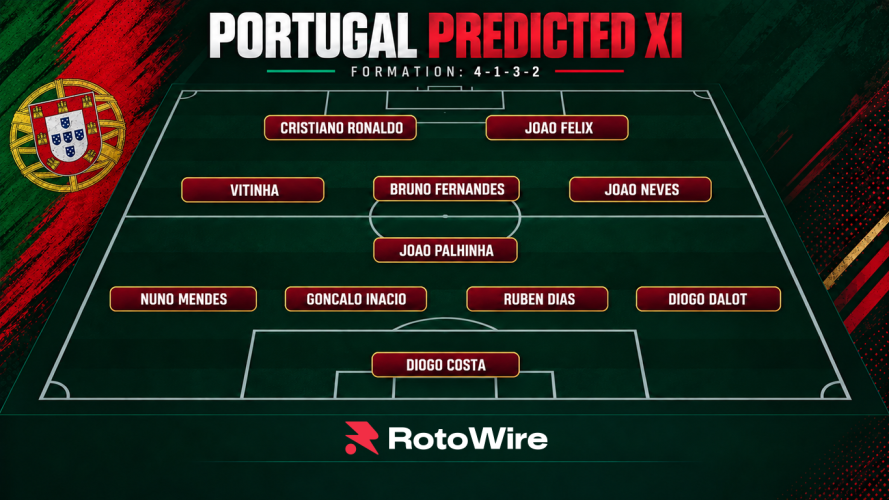
Cristiano Ronaldo and Joao Felix in a Two-Forward System
One of Jorge Jesus' clearest tactical preferences is using a second forward rather than simply adding another central midfielder when the matchup allows it.
That does not necessarily mean Portugal will play with two conventional strikers. The second attacker can operate underneath Ronaldo, move between midfield and the front line or drift into spaces created by the center forward.
Joao Felix is perhaps the most obvious fit. Jesus does not view him as a winger and has said the forward fits his ideas better as either a second striker or, eventually, even the main center forward because of his finishing ability, creativity and quality in tight spaces.
Joao Felix's position is one of the clearest examples of how Jesus could reinterpret Portugal's squad.
Jesus does not view Felix as a winger. He has said the forward fits his ideas better as either a second striker or, eventually, even the main center forward because of his finishing ability, creativity and quality in tight spaces.
That could be significant for both Felix and Portugal.
Instead of starting wide and constantly moving inside, Felix could receive possession centrally between the opposition midfield and defensive lines, closer to Ronaldo and closer to goal.
A Ronaldo-Felix partnership would also give Portugal two different attacking profiles. Ronaldo can remain the primary penalty-box reference, while Felix drops between lines, combines with midfielders and creates the connections around him.
Jesus has not confirmed that Felix will automatically start beside Ronaldo. In his latest press conference, he said several players have the characteristics to operate alongside the captain. But the broader tactical direction clearly favors a player with Felix's profile, especially since he plays with Ronaldo in Saudi Arabia.
Ronaldo's role has become even clearer ahead of Jesus' first match.
The coach confirmed that, barring a late issue, Ronaldo will start. However, he stopped short of guaranteeing that the captain will play the entire match, saying the flow of the game and Ronaldo's physical condition will determine his minutes.
That distinction matters. Jesus recognizes Ronaldo's unique status within Portuguese soccer, but he has consistently maintained that reputation alone will not determine his selections. When announcing his first squad, he said performance would ultimately decide whether Ronaldo plays, just as it does with every other member of the team.
Ronaldo also revealed that he considered retiring from international soccer following the 2026 World Cup before conversations with Jesus and Portuguese federation president Pedro Proenca convinced him he could still contribute. He remains focused on helping Portugal while continuing his pursuit of 1,000 career goals.
For Jesus, the challenge is therefore not deciding whether Ronaldo belongs. It is designing an attack that maximizes what Ronaldo still does best while reducing the areas in which Portugal need him to contribute.
A second striker could be a major part of that solution.
Joao Palhinha and Portugal's New Midfield Balance
The return of Joao Palhinha to the Portugal squad is another important tactical clue.
Jesus prefers having a true positional midfielder who understands both defensive and attacking responsibilities, protects the center-backs and provides balance when teammates move forward.
Palhinha fits that description extremely well. The coach has worked with him before and included him among four notable additions to his first Portugal squad. Jesus also pointed to Ruben Neves as another player capable of handling the same role, meaning the position could be adapted according to the opponent.
Palhinha offers ball-winning, physicality and defensive coverage. Ruben Neves provides more distribution and passing range from deeper positions.
Either way, the principle remains the same. Jesus wants one midfielder taking greater responsibility for the space in front of the defense, which could give Portugal's more creative players significantly more freedom.
That change creates one of the biggest selection questions of the Jesus era.
Portugal have enough midfield quality to start Vitinha, Joao Neves and Bruno Fernandes together, as Martinez often did. But if Jesus uses a dedicated holding midfielder and another striker, there may no longer be space for all three simultaneously.
That does not mean any of them suddenly become unimportant. Instead, their responsibilities could change according to the system.
Vitinha can dictate possession from deeper positions. Joao Neves provides exceptional pressure and ball recovery. Bruno Fernandes offers creativity, goals and final-third production.
Jesus' challenge is deciding which combination provides the correct balance around the holding midfielder and front two.
That competition for places may become one of the defining stories of his first year.
For the latest availability across Europe, see RotoWire's soccer injury report.
Rafael Leao, Nuno Mendes and Portugal's Width
Rafael Leao is another player whose international position could change.
Jesus previously coached Leao at Sporting and has pointed out that he used him as a central forward rather than purely as a left winger. He believes those characteristics remain part of Leao's game.
That gives Portugal another tactical alternative. Leao's pace and direct running make him devastating when starting wide, but using him centrally could be especially effective against teams defending with a high line.
It also reinforces the broader theme of Jesus' approach. Players will not necessarily occupy the same positions for Portugal that they use every week at club level. Jesus has explicitly said the same squad can produce a different style simply by changing roles, responsibilities and positioning.
Portugal's full-backs should also be important to the new system. Jesus has traditionally favored aggressive full-backs, and his first squad includes several players capable of providing significant attacking output from those positions.
Nuno Mendes is the clearest example. Jesus has specifically contrasted his own interpretation of Mendes with how manager Luis Enrique sometimes uses him at PSG. While Mendes can provide defensive balance and form part of a back three in possession for his club, Jesus sees the same player through a more attack-minded lens.
That could lead to Mendes pushing higher and earlier for Portugal. If Palhinha or another holding midfielder stays positioned in front of the center-backs, the structure becomes easier to balance when a full-back attacks.
Portugal could therefore create width through the full-backs while allowing players such as Felix, Bruno Fernandes or Leao to move into more central positions.
How Jorge Jesus Could Change Portugal With and Without the Ball
The differences should extend beyond formations. Jesus' club teams have generally defended aggressively, pushed their defensive line higher and tried to recover possession quickly after losing it.
Analysis has identified intensity as one of the potential differences between Jesus and Martinez. Both coaches want their teams to dominate possession and defend high up the pitch, but Jesus' teams have traditionally sustained that pressure more aggressively and for longer periods.
Portugal have personnel suited to that approach. Joao Neves is an elite pressing midfielder. Bruno Fernandes contributes heavily without possession. Portugal's wide attackers have enough athleticism to pressure defenders, while Palhinha can protect the space behind the press.
Winning the ball higher would also benefit Portugal's attacking talent by reducing the distance between possession recovery and goal. The risk comes behind that pressure.
Jesus' teams can defend extremely high, and implementing coordinated pressing triggers is more difficult at international level because coaches have far less training time.
This is where Jesus' latest comments are particularly important. Despite his promise to create a different Portugal, he has no intention of forcing every tactical idea into the team immediately.
Before his first match, Portugal had only one full field session under Jesus, with the previous day largely devoted to recovery. He acknowledged that attempting to introduce too much information at once could overwhelm players.
Instead, Jesus suggested that several players who already understand his tactical principles could provide the initial foundation.
13 players in his first squad have previously worked with him, which should shorten part of the adaptation process.
That makes the first international window more of a starting point than a finished tactical product.
Portugal may show elements of Jesus' preferred style immediately: a holding midfielder, greater positional freedom, a second striker and more aggressive pressing, but the complete version will require time.
One of the more revealing comments from Jesus before his debut concerned tactical variation.
He believes soccer is increasingly moving toward teams being able to change systems during matches rather than relying on one formation from kickoff to full-time. Portugal's technical quality and game intelligence give him the personnel to experiment with those shifts.
A nominal 4-4-2 could become a 4-2-3-1 in possession. A full-back moving forward could create a temporary back three.
Felix could begin alongside Ronaldo before dropping deeper to connect midfield. Portugal could also add another central midfielder when protecting a result or introduce another attacker when chasing one.
For Jesus, the formation may matter less than the relationships between players within it.
What to Expect From Portugal Under Jorge Jesus
The early evidence points toward several defining principles:
- A more flexible tactical structure rather than a fixed 4-3-3.
- One holding midfielder providing defensive balance, with Palhinha and Ruben Neves among the leading options.
- A greater willingness to use two forwards, especially against opponents Portugal expect to dominate.
- Cristiano Ronaldo remaining central, but without guaranteed minutes purely because of his status.
- Joao Felix used centrally, as a second striker or center forward rather than a winger.
- Rafael Leao potentially moving inside more often.
- More attacking freedom for the full-backs, particularly Nuno Mendes.
- Greater positional interchange in the final third.
- A more aggressive high press and defensive line.
- Tactical changes introduced progressively, rather than an immediate overhaul.
Jesus has repeatedly stressed that his interpretation of the game differs from Martinez's. The players may initially look familiar, but their positioning and responsibilities could make Portugal feel considerably different.
What Comes Next for Jorge Jesus and Portugal?
Portugal enter the new cycle as defending Nations League champions, and Jesus has made clear that retaining the trophy is an immediate objective rather than treating the competition solely as preparation for the future.
The first international window should answer some initial questions, but the more meaningful tactical picture will develop over time.
Does Palhinha become the regular holding midfielder? Can Joao Felix establish himself next to Ronaldo? Which of Vitinha, Joao Neves and Bruno Fernandes benefit most from the new structure? How aggressive will Nuno Mendes become? And how often will Jesus move away from three central midfielders?
Portugal's talent pool has changed very little. The way those players are positioned could change considerably.
And that is what makes the beginning of the Jorge Jesus era so compelling: one of international soccer's deepest squads is now being handed to a coach who has already made clear that he intends to use that talent differently.
For the latest Portugal team news and injury updates through the international window, see RotoWire's soccer news feed and injury report.


