


France Tactics Under Zinedine Zidane: Formation, Mbappe Role & Key Changes
Zinedine Zidane's first France squad offers the clearest indication yet of how Les Bleus could change after Didier Deschamps. The early signs point toward a 4-3-3 built around Kylian Mbappe attacking from the left, a fluid central forward and greater creative freedom for players such as Michael Olise and Rayan Cherki.
Friday's UEFA Nations League match against Turkiye will provide the first competitive look at that approach. Injuries have already forced adjustments to Zidane's expected XI, but the larger tactical direction is beginning to take shape.
Zidane was officially appointed following the end of Didier Deschamps' tenure and immediately made clear that he intends to put his own stamp on France. His first squad included several changes, while Mbappe remained captain and the initial team shape pointed toward a more attack-minded approach.
How France Could Line Up Under Zinedine Zidane
Zidane's first France side is expected to take shape in a 4-3-3, with Mbappe starting from the left, Dembele through the middle and Olise on the right. The midfield should feature Kone at the base, Rabiot providing balance and Cherki operating as the most advanced creator.
France predicted XI (4-3-3): Mike Maignan; Jules Kounde, Maxence Lacroix, Dayot Upamecano, Andy Diouf; Manu Kone, Adrien Rabiot, Rayan Cherki; Michael Olise, Ousmane Dembele, Kylian Mbappe.
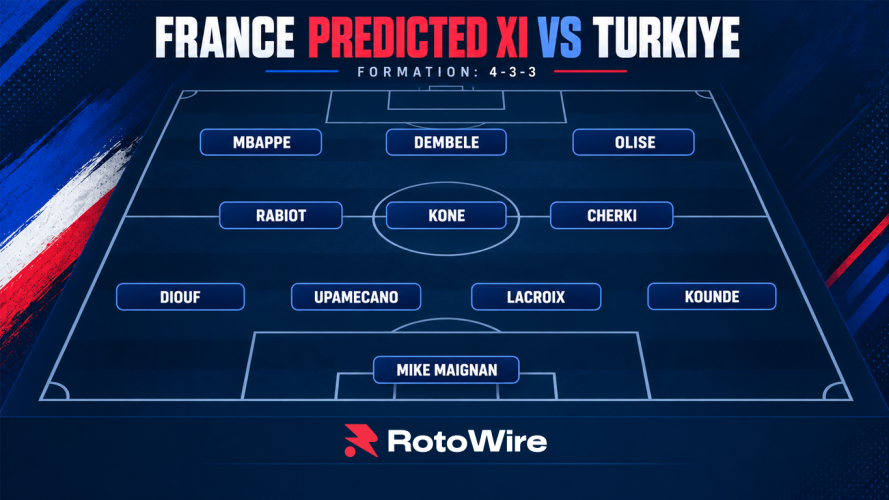
Konate had initially been projected to partner Dayot Upamecano in central defense, but his knee sprain likely opens the door for Lacroix, although Jeremy Jacquet could also benefit from the former Liverpool center-back's absence.
The front three is the more significant tactical development. Mbappe should be positioned on the left wing since Zidane said in the presser that he loves to see him in that position, Dembele through the middle and Olise on the right, giving France three attackers capable of switching positions and carrying the ball at defenders.
Cherki's inclusion in midfield adds another creative layer, with Adrien Rabiot providing balance and Kone expected to handle the deepest midfield responsibilities during this international window.
Check out RotoWire's full France-Turkiye match preview with predicted lineups and team news.
What Zidane's Real Madrid Tactics Tell Us About France
Zidane's Real Madrid sides were usually built around a clear 4-3-3 structure rather than an overly complicated tactical system.
At Madrid, Luka Modric controlled tempo, Casemiro protected the defense and Toni Kroos dictated play from deeper areas. Cristiano Ronaldo, Gareth Bale and Karim Benzema were then given freedom to combine and make decisions in the final third.
That philosophy matters when projecting how France could play.
Zidane has never been defined by a rigid positional system. His strength was creating a stable structure around elite players and giving them enough freedom to decide matches.
France have the personnel to follow a similar model.
Mbappe can attack from the left. Dembele can drift from the center into wide areas. Olise can create from the right half-space, while Cherki provides the kind of improvisation between the lines that France have often lacked.
Kylian Mbappe's Role Under Zinedine Zidane
The biggest tactical change could also be the simplest.
Mbappe is expected to start from the left rather than being used primarily as a central striker.
During the later stages of Deschamps' tenure, Mbappe increasingly moved toward the middle. That helped France maintain certain defensive structures, but it also reduced the amount of space available for him to attack defenders at speed.
Zidane's projected system puts him back where he can be most dangerous.
From the left, Mbappe can receive facing goal, isolate full-backs and make diagonal runs into the penalty area. Dembele's movement through the middle should also create space for Mbappe to attack inside rather than forcing him to stay wide.
The initial predicted lineup therefore looks designed around France's most dangerous attacker rather than asking him to adjust to the rest of the system.
Rayan Cherki Could Be the Biggest Winner Under Zidane
Few France players may benefit more from the coaching change than Rayan Cherki.
Cherki has long been regarded as one of the most naturally creative French players of his generation, but his international pathway has been complicated by questions about defensive discipline and positional structure.
Zidane appears willing to embrace what makes him different.
Cherki is expected to play as the most advanced member of the midfield three, operating between the lines and connecting France's midfield with Mbappe, Dembele and Olise.
That role allows him to receive on the turn, carry possession toward the box and attempt the disguised passes that have become a defining part of his game.
The defensive demands will still matter. Cherki cannot simply operate as a traditional No. 10 without contributing off the ball, particularly in a three-man midfield.
But Zidane's system could ask him to press intelligently rather than constantly, allowing France to preserve his energy for the areas where he can change matches.
The initial lineup clearly points toward Cherki being given a major creative role.
Aurelien Tchouameni's Role in Zidane's France
Aurelien Tchouameni's absence from Zidane's first squad is tied to his current fitness and rhythm at Real Madrid rather than necessarily signaling a long-term change in the midfield hierarchy.
For this window, Manu Kone is expected to handle the deepest midfield role behind Adrien Rabiot and Rayan Cherki. That gives Zidane a more mobile midfield for his first matches, while Tchouameni's eventual return would offer a different option built around positioning, ball recovery and distribution from deeper areas.
How Zidane balances that defensive control with the freedom given to Cherki and France's front three will be one of the main questions in future windows.
For the latest availability across Europe, see RotoWire's soccer injury report.
Ousmane Dembele's Role Through the Middle
Dembele's role as the central forward is another important clue about Zidane's attacking plan.
Rather than using a traditional target striker, France can deploy a fluid front three.
Dembele is capable of dropping away from the defensive line, receiving between midfield and defense and creating space for Mbappe and Olise to attack centrally.
That makes France considerably less predictable.
If Dembele drops into midfield, Mbappe can move inside. If Mbappe stays wide, Cherki can attack the central space. Olise can either hold width or move into the half-space.
Those rotations are exactly the kind of freedom Zidane encouraged during his most successful periods with Real Madrid.
The absence of Marcus Thuram from the first squad also reinforces the possibility that Zidane prefers a more mobile and technical profile through the middle rather than a classic physical center forward.
How France Could Play Under Zidane
The first version of Zidane's France appears likely to be built around four key principles:
- Mbappe attacking from the left, where he can isolate defenders and attack space.
- A fluid central forward, with Dembele able to drop and create just like he does with Paris Saint-Germain.
- More creativity in midfield, particularly through Cherki.
- A simple 4-3-3 structure that gives France's best players freedom in possession.
There will still be questions.
France need enough defensive protection behind Cherki. The midfield balance could change once Tchouameni returns. Lacroix now has to settle quickly alongside Upamecano, while Zidane will also need to determine how aggressive his full-backs can be without leaving the center-backs exposed.
But the early direction is clear. Zidane does not appear interested in completely rebuilding France tactically. He is reorganizing the team to place its most talented attacking players in roles that maximize what they already do best.
What Comes Next for Zidane and France
Turkiye provides the first competitive test, but Zidane's project will be judged over several international windows rather than one match.
The return of Tchouameni should eventually give France another midfield configuration to explore, while the competition at center-back will continue once Konate is healthy again.
The biggest long-term questions surround the attacking structure.
Can Cherki become a permanent starter? Can Dembele consistently lead the line with France and impact games like he does with PSG? Does Mbappe's return to the left unlock another level for France?
Those answers will shape Zidane's first year in charge and ultimately determine how different this France team becomes from the one Deschamps left behind.
France's next cycle is already being built around the 2030 World Cup, with Mbappe, Olise and Cherki forming part of a generation that should remain central to the team over the coming years.
For the latest France team news and injury updates through the international window, see RotoWire's soccer news feed and injury report.


