





Are small-school prospects better fantasy options than big-school players?
It seems like the impact of small-school players in the pros grows every season. Players like Vincent Jackson (Northern Colorado) and Marques Colston (Hofstra) have turned in dominant fantasy seasons, despite their humble college beginnings.
Intuitively, it makes sense small-school prospects would be undervalued. As the overall talent level of college players grows, the gap between the big and small schools will shrink. That's primarily because the ground to gain for the elite college prospects is so much smaller than that for, say, DI-AA players, so the latter prospects have been able to "catch up." I also think the fact that NFL teams can find talent from any school has allowed talented high school athletes to attend smaller universities.
Whatever the reason, I've found some evidence in the past that small-school players are undervalued by NFL teams. However, I was interested in knowing if small-school skill position players have been superior to their big-school counterparts as fantasy producers.
The Numbers on Small-School Prospects
I decided to break up the data into two primary categories, sorting it by position and round. Since small-school players typically get drafted later, it wouldn't make sense to compare all small-school quarterbacks to all BCS quarterbacks, for example, because the latter group should be expected to produce at a higher level from their draft slot alone.
I'm more concerned with looking at, say, a third-round prospect and trying to figure out if his college can give us
Are small-school prospects better fantasy options than big-school players?
It seems like the impact of small-school players in the pros grows every season. Players like Vincent Jackson (Northern Colorado) and Marques Colston (Hofstra) have turned in dominant fantasy seasons, despite their humble college beginnings.
Intuitively, it makes sense small-school prospects would be undervalued. As the overall talent level of college players grows, the gap between the big and small schools will shrink. That's primarily because the ground to gain for the elite college prospects is so much smaller than that for, say, DI-AA players, so the latter prospects have been able to "catch up." I also think the fact that NFL teams can find talent from any school has allowed talented high school athletes to attend smaller universities.
Whatever the reason, I've found some evidence in the past that small-school players are undervalued by NFL teams. However, I was interested in knowing if small-school skill position players have been superior to their big-school counterparts as fantasy producers.
The Numbers on Small-School Prospects
I decided to break up the data into two primary categories, sorting it by position and round. Since small-school players typically get drafted later, it wouldn't make sense to compare all small-school quarterbacks to all BCS quarterbacks, for example, because the latter group should be expected to produce at a higher level from their draft slot alone.
I'm more concerned with looking at, say, a third-round prospect and trying to figure out if his college can give us some insights into his potential NFL production. To grade that production, I used approximate value from Pro Football Reference, which is a pretty good catch-all metric that combines all relevant fantasy numbers.
Quarterbacks
Right off the bat, I found BCS quarterbacks (those from the big conferences) have outperformed non-BCS quarterbacks, even after adjusting for draft round.
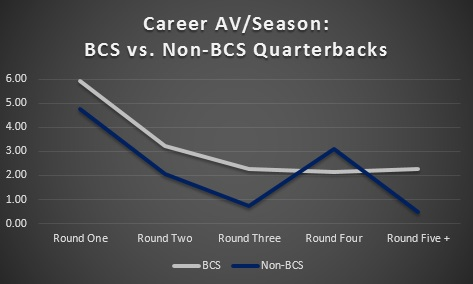
Outside of the fourth round, BCS quarterbacks have recorded better fantasy stats than non-BCS passers. The deviation from that trend is likely just due to variance.
First and second-round small-school quarterbacks have been particularly poor. Outside of a handful of names (Ben Roethlisberger Daunte Culpepper, and perhaps Joe Flacco and Alex Smith), most have been busts or mediocre at best: J.P Losman, David Carr, Patrick Ramsey, Kevin Kolb, John Beck, Shaun King and Charlie Batch among them.
Note that Tony Romo (Eastern Illinois) wasn't included in this analysis because he went undrafted. His presence wouldn't significantly alter the results. The sample (which contains 156 quarterbacks over a 15-year period) is large enough to conclude you probably want to favor BCS quarterbacks.
I think big-school quarterbacks have found more NFL success for a few reasons. First, great quarterbacks are typically heavily recruited out of high school, so the best rarely sign with non-BCS schools.
Further, playing quarterback in the NFL seems to take a level of confidence that surpasses that required for every other position, and quarterbacks from schools like Alabama, Notre Dame, USC, Florida State, and so on seem like they're probably better equipped to deal with pressure and adversity. It's not that small-school quarterbacks can't be confident in their abilities - Joe Flacco has perhaps the most undeserved sense of arrogance I've ever witnessed, for example - but they aren't necessarily forced to deal with adversity on a consistent basis, so it can be difficult to determine if they have what I call "Goldilocks arrogance" (just enough to not care about what people say, but not so much that they fail to work hard).
Running Backs
If there's one position I thought would stand out in this analysis in favor of small-school options, it was running back. That's because running backs are so dependent on their offensive lines for production it can become really difficult to grade them. We see in the NFL, as running backs drafted in the third round or later have actually been more efficient than first and second-round backs since 2000. Wow. NFL scouts are typically a conceited bunch who throw out vague, meaningless buzzwords to display their intricate "knowledge" of the game, but they have almost no clue what they're doing when it comes to running backs. That the NFL draft is as inefficient as it is after all this time is a disgrace to the scientific process.
Moving on. Here's the data on BCS vs. non-BCS running backs.
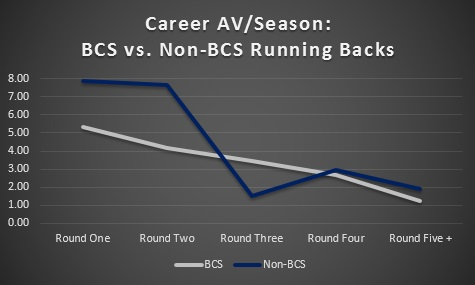
NFL teams have been horrible when it comes to drafting running backs in the early rounds. Among the first and second-round misses are Trent Richardson, Mark Ingram, Ryan Williams, Daniel Thomas, Jahvid Best, Toby Gerhart, Montario Hardesty and Beanie Wells. There are others, too; that's just what I can remember from the past few drafts alone.
Meanwhile, there have been six non-BCS running backs drafted in the first two rounds since 1995: Ryan Mathews, Chris Johnson, LaDainian Tomlinson, DeAngelo Williams, Antowain Smith and Matt Forte. Not all of those have been superstars, but Tomlinson is one of the most productive backs in NFL history, and Smith is the only arguable miss.
That's not a huge sample size and non-BCS running back success hasn't extended to later in the draft, but there's no clear BCS advantage as there is with quarterbacks.
Wide Receivers
Wide receiver is an interesting position because, up until very recently, most organizations were valuing the wrong traits in prospects. Whereas many teams still covet blazing-fast play-makers like Tavon Austin, it's the big, physical receivers who have been the most successful in the pros. Austin's value would soar if the NFL awarded points for running horizontally across the field. But as long as it requires teams to get into the end zone to score, players like Austin will be overvalued.
Such market inefficiencies can be exploited in the mid and late rounds, when shrewd teams acquire players who should have gone earlier for a cheaper price. A 6'3", 220-pound small-school prospect can make for an intriguing third-round pick, for example. Either way, here's the data on BCS vs. non-BCS wide receivers.
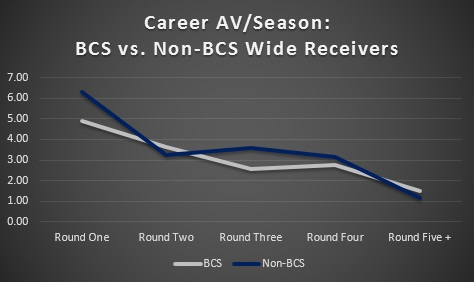
The non-BCS players have performed slightly better overall, but these lines are pretty similar. It's interesting to see another advantage for non-BCS first-rounders, which I think is the result of two things. First, first-round non-BCS receivers Randy Moss and Roddy White were pretty good I think, right? That helps. Second, NFL teams probably require a higher level of confidence to take a small-school prospect early in the draft. When a player like Moss is selected in the first round despite his off-field concerns and playing weak competition at Marshall, you know he's a stud.
Tight Ends
Finally, let's take a gander at the tight ends.
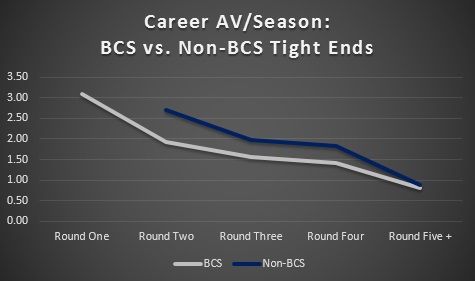
Interestingly, there have been no small-school tight ends taken in the first round since 1995. That's not completely surprising since the position was never really considered of incredible importance. In every other round, though, non-BCS tight ends have outperformed their big-school counterparts.
When you see a relatively small effect like the one with tight ends, you can't really be sure it's meaningful. You can acquire more meaning when a bunch of small effects begin to add up, however, and I think that's what we're seeing with small-school running backs, wide receivers, and tight ends.
Whereas I believe there's good evidence to suggest BCS quarterbacks should make for the best pros, that's not the case for BCS players at other positions. With the number of players in this study (more than 1,000), the sample is large enough to conclude non-BCS players at most positions appear to be undervalued. They aren't inherently better than big-school players, of course, but just better values when you consider the cost of drafting them.
When the School Matters
When an MLB player breaks out in his age-20 season with a .326 average, 30 home runs, and 83 RBI, you can pretty much bet he's going to be an outstanding pro. You can throw away how much time he spent in the minors or how much he got on base in college; with 162 games, one elite MLB season is a pretty significant sample.
That's not the case in the NFL. Ten seasons of NFL data isn't as much as even a single MLB season, so there's a huge amount of variance inherent to most stats.
This means, while you shouldn't be concerned about a player's college origins in his fifth NFL season, it can still have meaning a year or two into his career.
When Matt Forte broke out in his rookie season, perhaps we should have had a little more confidence in his career path knowing that, coming from Tulane, he was perhaps undervalued (relative to other running backs). And maybe the opposite can be said of Felix Jones, who was highly efficient in his first two NFL seasons but never produced quality fantasy numbers, despite playing college ball in the SEC.
By no means do I think you should be selecting first and second-year players based solely on their schools. But if you're in a dynasty draft or even if you're choosing between two rookies in a re-draft league, keep in mind NFL teams have typically been overly bullish on big-school names at every position other than quarterback.
Jonathan Bales is the author of the Fantasy Football for Smart People book series. He also runs the "Running the Numbers" blog at DallasCowboys.com and writes for the New York Times.