






Using Numbers to Predict WR Breakouts
They say that success equals opportunity plus preparation, but for NFL players, that simple equation needs to be refined. Namely, we need to add in "athleticism" as another variable:
Success = Opportunity + Preparation + Athleticism
That looks better. The reason athleticism - which I'm using broadly here to encapsulate all physical measurables - is so important as a predictor is because we see the same types of players succeed again and again.
As I've showed in the past few weeks, you want to search for explosive running backs, as measured by the 40-yard dash and broad jump, who were drafted highly. For tight ends, the draft round and vertical jump - a measurable that doesn't matter at all for running backs - are the best tools for forecasting success at the position.
Another reason measurables are important is they're often overlooked or misunderstood by fantasy owners. Prior to each season, we all have a pretty good idea of each player's projected workload. Opportunities are extremely important, but you aren't likely to obtain much of an advantage by out-projecting owners in that area.
Preparation is important, obviously, but I think it's a little bit overblown as a factor in predicting future success. For one, preparation should already be reflected in past statistics. If preparation really matters, it should show up on the field. And if it doesn't, well, who cares about it then? Second, we're dealing with professional athletes here. You might have
Using Numbers to Predict WR Breakouts
They say that success equals opportunity plus preparation, but for NFL players, that simple equation needs to be refined. Namely, we need to add in "athleticism" as another variable:
Success = Opportunity + Preparation + Athleticism
That looks better. The reason athleticism - which I'm using broadly here to encapsulate all physical measurables - is so important as a predictor is because we see the same types of players succeed again and again.
As I've showed in the past few weeks, you want to search for explosive running backs, as measured by the 40-yard dash and broad jump, who were drafted highly. For tight ends, the draft round and vertical jump - a measurable that doesn't matter at all for running backs - are the best tools for forecasting success at the position.
Another reason measurables are important is they're often overlooked or misunderstood by fantasy owners. Prior to each season, we all have a pretty good idea of each player's projected workload. Opportunities are extremely important, but you aren't likely to obtain much of an advantage by out-projecting owners in that area.
Preparation is important, obviously, but I think it's a little bit overblown as a factor in predicting future success. For one, preparation should already be reflected in past statistics. If preparation really matters, it should show up on the field. And if it doesn't, well, who cares about it then? Second, we're dealing with professional athletes here. You might have the occasional lazy prospect, but for the most part, these guys are where they are because they've prepared for it.
Meanwhile, I rarely see fantasy owners looking up a potential draft pick's broad jump. But perhaps we should be doing that, especially with younger players.
The most obvious rebuttal is that NFL teams are relatively efficient at drafting, so the only thing we really need to study when projecting young players is their draft round. Let the scouts do the work.
I don't really think NFL organizations are all that efficient at what they do, though. If they were, we wouldn't see players like Tavon Austin - who will continually be overvalued in standard fantasy leagues - or Robert Woods drafted ahead of guys like Keenan Allen. We wouldn't see Kendall Wright drafted higher than Alshon Jeffery. We certainly wouldn't see Joseph Randle ahead of both Andre Ellington and Zac Stacy (I made these claims prior to the respective players' careers, so it's not a 20/20 hindsight situation).
Draft round is important because it helps us predict opportunities, which are of course important. They're even more important for wide receivers than I previously thought.
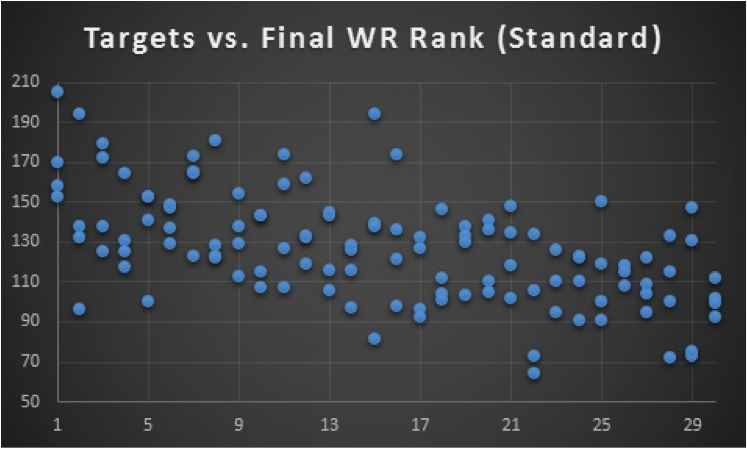
But again, short-term opportunities are easy for everyone to predict. If you can predict which types of players are worth their draft spots - and thus likely to continue to 1) receive opportunities to make plays well into the future and 2) actually make those plays - you'll be a step ahead of the competition.
Wide Receiver Measurables
I charted the Combine measurables for every wide receiver drafted over the past decade (excluding rookies from this year), comparing them to the players' approximate value (a metric that combines various stats like catches, yards, touchdowns, etc.) Here's what I found:
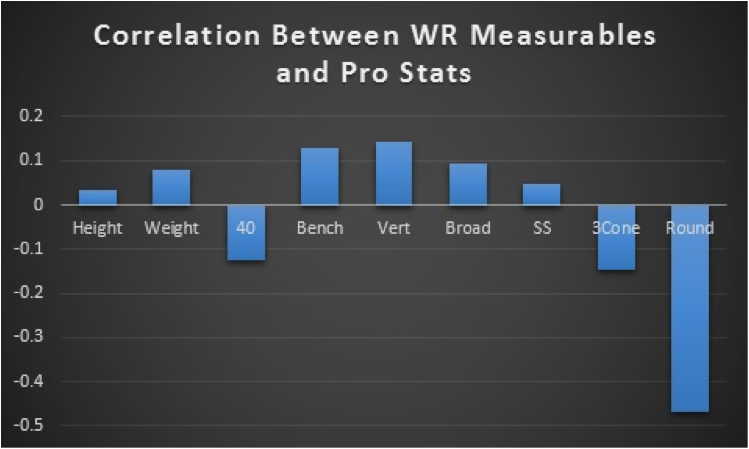
Note that it doesn't matter if the bars in the graph are positive or negative; all that matters is the length.
Again, draft round is the biggest predictor of future NFL success, and it isn't even close. But again, because pretty much everyone is going to be valuing that readily available information, you aren't going to be able to use it to acquire any sort of competitive advantage.
The next most predictive measurables for wide receivers, however, are ones most of your competitors won't be examining - the three-cone drill and the vertical jump. We actually saw a very similar phenomenon with tight ends, which makes sense.
The vertical jump's worth to wide receivers and tight ends is pretty obvious, but what about the three-cone drill? I've found with every position that the three-cone drill (and the broad jump) are underrated explosiveness metrics.
That's in opposition to the short shuttle, which is perhaps the most overrated measurable out there. The short shuttle isn't predictive for any position, but especially not for wide receivers; you can see the correlation between the short shuttle and wide receiver stats is positive, meaning wide receivers who have run slower in the short shuttle have actually been better in the NFL!
The most surprising data is that the correlation between height/weight and NFL success is relatively weak. That's really shocking to me since I've found the best wide receivers are often big, strong players who can excel in the red zone in a consistent manner.
I think the numbers might be a little skewed by the fact that there are so many non-producing players in the data set. A lot of wide receivers get drafted, but few end up contributing meaningful numbers. That might have diluted the results just a bit.
Another possible explanation is NFL teams aren't really valuing height and weight all that much, as we've seen with the recent early selections of players like Austin, Wright and Randall Cobb. Those players are obviously given chances to succeed due to their draft slots, so their numbers are perhaps inflated from opportunities alone.
The reasons I think both height and weight still matter quite a bit is the game's elite wide receivers all have size in common. Take a look at the top-20 wide receivers in approximate value over the past decade.

The elite class checks in better everywhere except for the short shuttle (surprise, surprise). But the gap in size, particularly weight, is largest. The top-20 wide receivers over the last 10 seasons have weighed over 209 pounds. The average drafted wide receiver who attended the NFL Scouting combine weighed just 201.8 pounds. Compare that to only moderate jumps in the 40-yard dash, bench, vertical, broad jump and three-cone drill.
Because of that, my conclusion is different types of wide receivers can be productive, namely those who are drafted highly. But the dominant wide receivers - the Calvin Johnson, Dez Bryant, Demaryius Thomas, Julio Jones, A.J. Green, Brandon Marshall, Alshon Jeffery, Josh Gordon, Andre Johnson, Vincent Jackson-esque players - might not all run that fast or have elite broad jumps, but they all possess elite size.
Jonathan Bales is the author of the Fantasy Football for Smart People book series. He also runs the "Running the Numbers" blog at DallasCowboys.com and writes for the New York Times.